

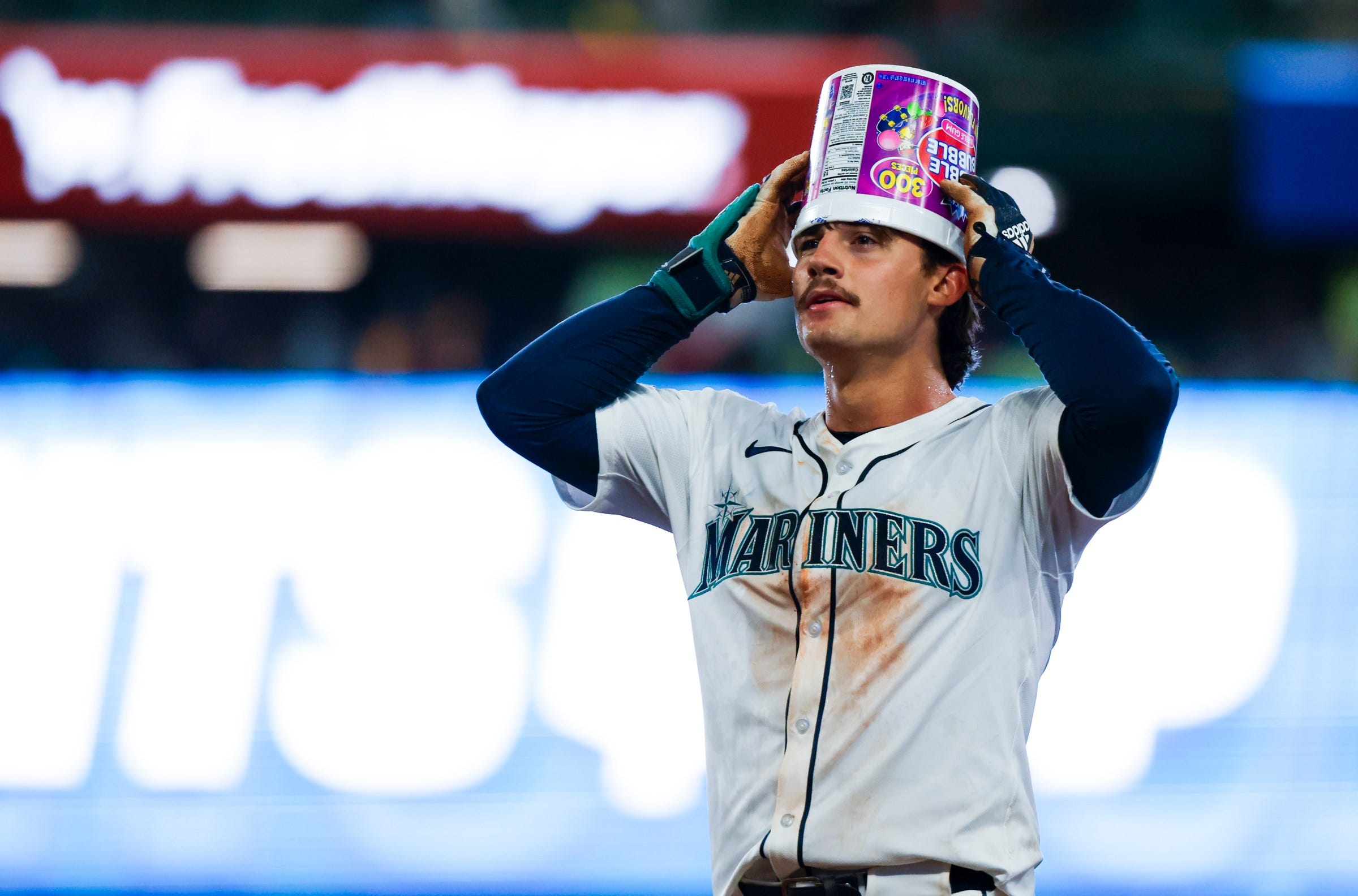
When looking for the bright spots in what has so far been an up and down start to the 2026 season for the Seattle Mariners, the continued growth and development of Cole Young stands out as one of the brightest.
As I discussed on my initial podcast back in February, Cole Young’s physical appearance was one of the things that stood out to me the most during my time in Peoria. Ryan Rowland-Smith recently discussed the same, while also echoing the sentiment that Young came into the season in much better shape than he was in 2025:
He’s in way better shape than last year. People don’t talk about that,” Rowland-Smith said. “… Everything he did in the winter was based around, I need to be overmatched. When I set up a (pitching) machine, I’m going to set it up belt high, as fast as this machine can go. I’m going to use these softballs that Driveline makes… and they rise on you. And that was his whole emphasis.
Young’s approach during the off-season, as well as the rumored adjustments to his diet, have already shown dividends through the first 31 games of the season. Young currently ranks in the top 10 in both WRC+ and fWAR amongst second basemen, and has also seen significant growth defensively, specifically on balls he’s needed to charge, as well as his lateral movement towards the second base bag:

Overall, Young has seen significant, and in some instances comical (shoutout bWAR) growth since 2025:

Now to be clear, I am not of the mindset that Cole Young is a nine win player (that distinction belongs to Brendan Donovan IYKYK) - but a still 22 year old second baseman pacing towards a four win season is certainly someone the Seattle Mariners would likely look at as an extension candidate - but what would that extension look like?
Player Comparisons
To start, I filtered by players since 2000 who have had at least 350 PAs in their age 21-22 year old seasons as our initial list. From that list, there are the expected suspects leading the way in terms of production (Gleyber Torres, B.J Upton, Ozzie Albies, Robinson Canó), but there were also players like Brandon Phillips and José Ramirez who struggled mightily in their debuts who were pulled into the filter. In total, there were 26 players who fit this criteria, with the below being the best comparisons:

At first glance, this is certainly a list of players who you know/remember! Hilariously enough, there are four current or past Mariners on this list, with the best of the bunch being a part of one of the worst trades in Mariners history.
From this group, Nick Franklin was the only player who really busted, finishing with a career .214/.285/.359 line before his major league career ended in 2018. Franklin peaked as the 52nd overall prospect on MLB Pipeline the year prior to his debut, and had a good debut season at the age of 22, but was never able to build on the power/defense profile he displayed as a rookie.
Colt Keith was the only player who signed a pre-arb extension from the group, a 6 year, $28.64m contract with three club options - $10m, $13m, $15m - each of which come with buyouts ranging from $1m to $2.64m.
At the time of his extension, Keith had yet to debut for Detroit, and had posted a .300/.382/.512 line over 1,063 PAs in the minors. In comparison, Cole Young had posted a .279/.388/.432 line over 1,473 PAs prior to his debut.
Luis Rengifio never signed an extension, but through arbitration and his free agent deal he signed this off-season, Rengifio has made roughly $25.8m through the age of 29.
Jackson Holliday is easily the most high profile name of the group, and was the top overall prospect in baseball on MLB Pipeline in 2024. Holliday showed significant growth from 2024 to 2025, and was poised for a breakout season in 2026, but a fractured hamate in spring training has slowed his debut for this season.
Financially, and in terms of overall success, Asdrúbal Cabrera had the best overall result of the group (so far). Cabrera amassed 28.3 fWAR while finishing with a .266/.329/.423 line over 7,401 PAs spanning a 15 year career. Cabrera’s career finished at the age of 35, and by the time he had retired, he had earned over $64m, mostly coming in one and two year deals after his time in Cleveland came to an end.
Contract Comps
Kristian Campbell
Contract: 8 years, $60m - Club Options in 2033 ($19m) and 2034 ($21m)
MLB Stats Time of Signing: 24 PAs, .400/.500/.750
Colt Keith
Contract: 6 years, $28.6m - Club Options in 2030 ($10m), 2031 ($13m) and 2032 ($15m)
MLB Stats Time of Signing: None
Ozzie Albies
Contract: 7 years, $35m - Club Options in 2026 ($7m) and 2027 ($7m)
MLB Stats Time of Signing: 982 PAs, .271/.321/.453, 103 WRC+, 6.8 fWAR
Rougned Odor
Contract: 6 years, $49.5m
MLB Stats Time of Signing: 1,519 PAs, .265/.302/.464, 101 WRC+, 6.4 fWAR
Jedd Gyorko
Contract: 5 years, $35m - Club Option in 2020 ($13m)
MLB Stats Time of Signing: 577 PAs, .241/.295/.430, 104 WRC+, 2.4 fWAR
Kolten Wong
Contract: 5 years, $25.5m - Club Option in 2021 ($12.5m)
MLB Stats Time of Signing: 1,108 PAs, .250/.303/.374, 88 WRC+, 4.0 fWAR
Scott Kingery
Contract: 6 years, $24m - Club Options for 2024 ($13m), 2025 ($14m) and 2026 ($15m)
MLB Stats Time of Signing: None
Average Guaranteed Contract: 6 year, $36.8m
Though I didn’t list him above, I do think it’s also important to reference Colt Emerson as well. The Mariners signed Colt to an 8 year, $95m contract earlier this season, which at the time, made him the highest paid player in Major League history who had yet to make his debut.
Colt is a clear cut above Cole in terms of prospect pedigree, as well as projected future value from most prospect rank sheets, but I do think it’s valuable to look at his contract through the arbitration years as a good barometer for where the Mariners could hypothetically land in discussions with Cole:
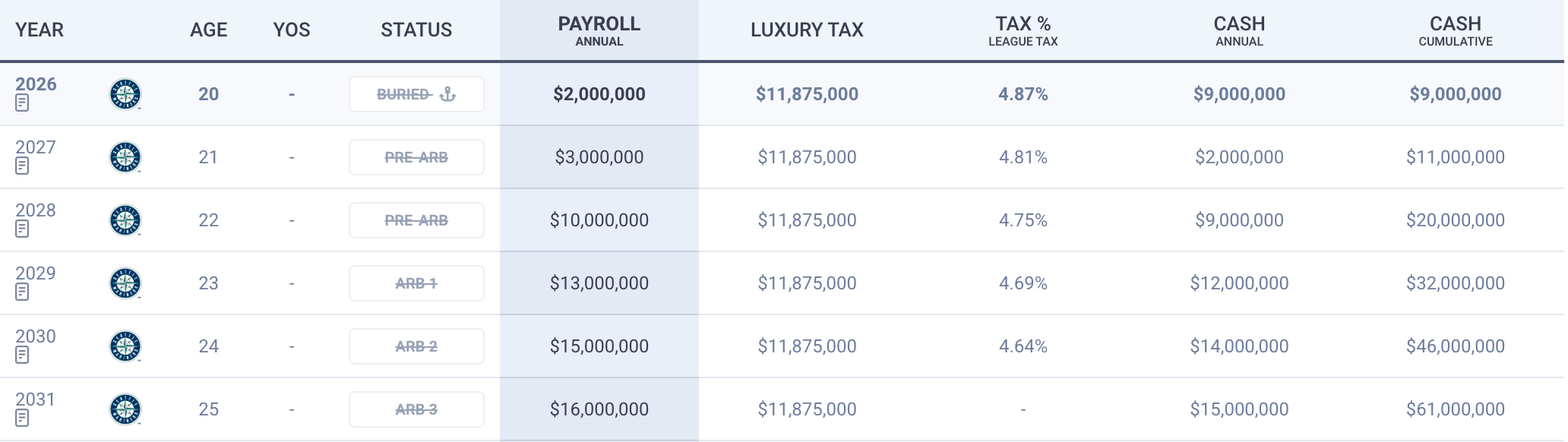
Colt’s total money earned through his pre-arb and arbitration years lands at 6 years, $59m, with the remaining money coming in the form of two additional guaranteed years at $18m AAV, with a club option in 2034 at $25m. I do not think that the money the Mariners are paying to Colt through pre-arbitration is a number they would look to offer Cole, primarily due Colt’s age, premium position and his better overall projection moving forward - but I could see the Mariners looking to offer something that lands around the average of the contracts above, and what they are paying Colt.
Extension Offer
Now, I can understand that the upcoming CBA negotiations, as well as the potential impact it could have on player control, could influence both the Mariners and Cole’s willingness to do a deal - but the point of this exercise was gathering enough comparisons, both statistically and contractually, to give a healthy projection of where I would land if I were in the front office’s shoes:
Contract Offer - 5 years, $31m with multiple club options
2026: $3m
2027: $4m
2028: $6m
2029: $8m
2030: $10m
Club Options: 2031 ($12m), 2032 ($13m), 2033 ($14m) - $2m buyouts on each year.
Total Potential Contract: 8 years, $70m
This contract essentially comes in as a beefier version of the Colt Keith deal, which gives both the Mariners, and Cole Young stability over the next five to eight seasons.
For Cole, $31m is very likely more than he will make through his pre-arbitration and arbitration process - but comes at the expense that he’s essentially working on rolling one year deals for the Mariners starting in his age 27 season.
Could Young get paid more than the 3/39m he could receive in club options once he hits the open market? Maybe - but in order to do that, Young would likely have to tap in to the power side of his game a little bit more, and turn more into an Asdrúbal Cabrera type offensive profile, while also maintaining a well above average defensive profile. Then again, there’s also the scenario that Cole Young does hit his 100th percentile outcome and still becomes a free agent at the age of 30 after already making $70m for his career, which in itself, is not a bad consolation prize.
For the Mariners, the benefits lie in locking up every position on the dirt with the exception of third base through at least 2030.
Even in the scenario where Young’s growth stunts, or objectively fails, the Mariners are looking at a slightly more expensive commitment than what tthey gave Evan White in 2019 - a contract they were able to trade, and would have no detrimental impact to your overall payroll.
Again - the uncertainty of the CBA and the future of the arbitration process certainly makes this a tricky conversation for both parties, but if Cole’s development continues through the 2026 season, I’m sure at least one of the parties will be open to having the discussions.