

As time has continued to distance me from the smoldering ash of the 2026 Seattle Mariners, I have gradually begun to rediscover my (very sick) hobby of trying to better understand why and how the Mariners have tried to build their roster, at least from an offensive perspective.
Obviously, I am not privy to the data that the Mariners organization likely gathers and analyzes to make their decisions over time, but I think it is also fair enough to say that the organization likely doesn’t make their decisions only on the data they collect alone. Regardless of organization, there are multitudes of factors that go into player acquisition. Whether that be clubhouse fit, financial fit, player reputation, age or any other designated soft skill data point, there are always outside factors other than datasets that organizations use in order to determine what steps they want to take in a player acquisition cycle.
With that said, I do think quotes made by Jerry Dipoto since the end of the season that, to me, have illustrated a want/need to getting back to a certain way of playing baseball:
I wake up and I look in the mirror every day trying to figure out why this happened. For the last five years, we're one of the winningest teams in Major League Baseball. This year, we stunk and it never got on track. - Jerry Dipoto
‘Accountability' is just a word unless you’re accountable to a standard that is preset, everybody understands what that standard is, and then we hold ourselves accountable to it. - Jerry Dipoto
The messaging since the end of the season from leadership in the Mariners organization has primarily focused on the ‘standard’ the Mariners have as an organization, as well as holding players to that standard - something both fans and clearly the organization felt the 2026 iteration of the Mariners clearly did not uphold.
But what exactly is ‘The Mariners Standard™’? What exactly is the standard players are expected to uphold, or at a minimum, the traits a players is supposed to display that makes them a fit for the Seattle Mariners? I’m sure some will say that Andy McKay’s departure had something to do with the drop off in 2026, which is easy to correlate given the Guardian’s current status in the ALCS. However, I personally do not believe that Andy McKay’s lack of musings, which often sounded like a mix of something Matthew McConaughey says in a Buick commercial and a fortune cookie from Mullet Review, had much to do with the Mariners 2026 drop off, especially given McKay wasn’t a clubhouse presence for Seattle in 2025.
No - I think Dipoto’s first of two quotes above has more to do with why the Mariners were bad in 2026. They just stunk, point blank, and sometimes that happens, and there really isn’t a need to identify a philosophical backing to justify it.
I do think Dipoto’s comments on standards had more to do with doing the little things better, or at a minimum, not being the absolute worst at multiple things. Defense and base running aren’t necessarily the easiest metrics to quantify, but there is certainly a difference between being bad and being complacent, and as Dipoto pointed out, I do think there were several Mariners who fell into one of those two buckets last year, and holding yourself to a standard (and not playing through non-insignificant injuries) can help raise the floor for the 2027 team that by and large will be returning a fairly significant portion of their roster.
With that said, I wanted to focus on something a little easier to quantify when looking to identify potential targets the Mariners could look at this off-season - with a primary focus on the glaring needs at Shortstop, Third Base and at least one Outfield spot. In order to try and quantify, as opposed to just using my opinion, I decided to go out on a w(h)im (more on that in a second) and try to focus on a set of criteria that has seen success in Seattle particularly - given the Mariners concerted efforts in looking for players they believe can hit in T-Mobile Park.
So without further adieu, I present:
The W.I.M (Will It Mariner) Model ™
In order to create a dataset we could measure against current non-Mariners, I decided to measure the best performing Mariners over the past five collective seasons who at a minimum had:
200 PAs in T-Mobile Park
100 WRC+ in T-Mobile Park
The key here was wanting to create a large enough dataset, essentially to the tune of an almost every day player spending a full season (81 home games) hitting, where we could use collective averages to better understand the hitting profiles of players who have succeeded in Seattle. Below, you will see a very familiar cast of characters, with some objectively hilarious inclusions (sup Josh Rojas, sup Jesse Winker, sup Victor Robles).
The criteria used for the WIM Model focused primarily on available batted ball data from Fangraphs (Line Drive, Ground Ball, Fly Ball, Pull, Center, Oppo, Hard Hit perecentages), as well as walk percentage and strikeout percentages, that could hopefully provide us with an average that we could use as our baseline to identify current non-Mariners who could hypothetically provide similar success if placed in Seattle. Now, as mentioned above, there are certainly outliers to this, and meeting these metrics doesn’t guarantee any given hitter is a better fit than another (more on that later) - but it can help us identify players who could be a fit more so than anything.
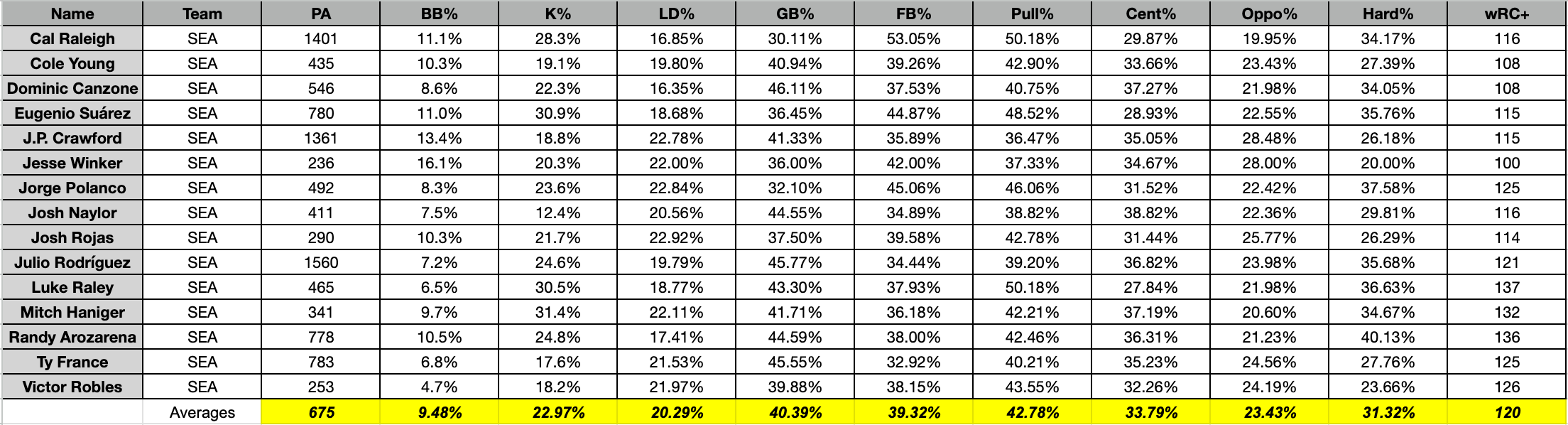
In yellow above, you’ll see our projected baseline we will use against all players in major league baseball who accumulated at least 650 PAs (675 was not available as a filter) over the same time frame (2022-2026) as the 15 Mariners above. Ideally, seeing a similar length of average track record in the same time frame could provide us with a potential correlation on success of hitters in Seattle to those who carry similar profiles elsewhere.
Now, in order to filter which players at each position best compared to the average of a successful hitter in T-Mobile Park, I used the averages in yellow above as a baseline, while also including some additional parameters:
Walk Percentage: Player qualifies for metric if player is equal or greater than 9.5% average.
Strikeout Percentage: Player qualifies for metric if player is equal or less than 23% average.
Line Drive Percentage: Player qualifies for metric if player is within 10% less or greater than 20% average (18% - 22%)
Ground Ball Percentage: Player qualifies for metric if player is within 10% less or greater than 40% average (36% - 44%)
Fly Ball Percentage: Player qualifies for metric if player is within 10% less or greater than 39% average (35% - 43%)
Pull Percentage: Player qualifies for metric if player is within 10% less or greater than 42% average (38% - 46%)
Center Percentage: Player qualifies for metric if player is within 10% less or greater than 34% average (30% - 38%)
Oppo Percentage: Player qualifies for metric if player is within 10% less or greater than 23% average (20% - 26%)
Hard Hit Percentage: Player qualifies for metric if player is equal or greater than 27.9% average.
WRC+: Player qualifies for metric if players is equal or greater than 100 WRC+ (league average)
With all of this said, the working theory here would be the more categories a player qualifies in, the higher the likelihood that player could fit the batted ball and approach averages that have seen success in terms of WRC+ in Seattle over the past five years - and in theory, could be players the Mariners could look to target this off-season (obviously prior to considering money, age, availability etc.).
Below, I will snap shot the top available players at each position, while also grabbing some tidbits that I found interesting from what the model produced.
Primary Third Basemen
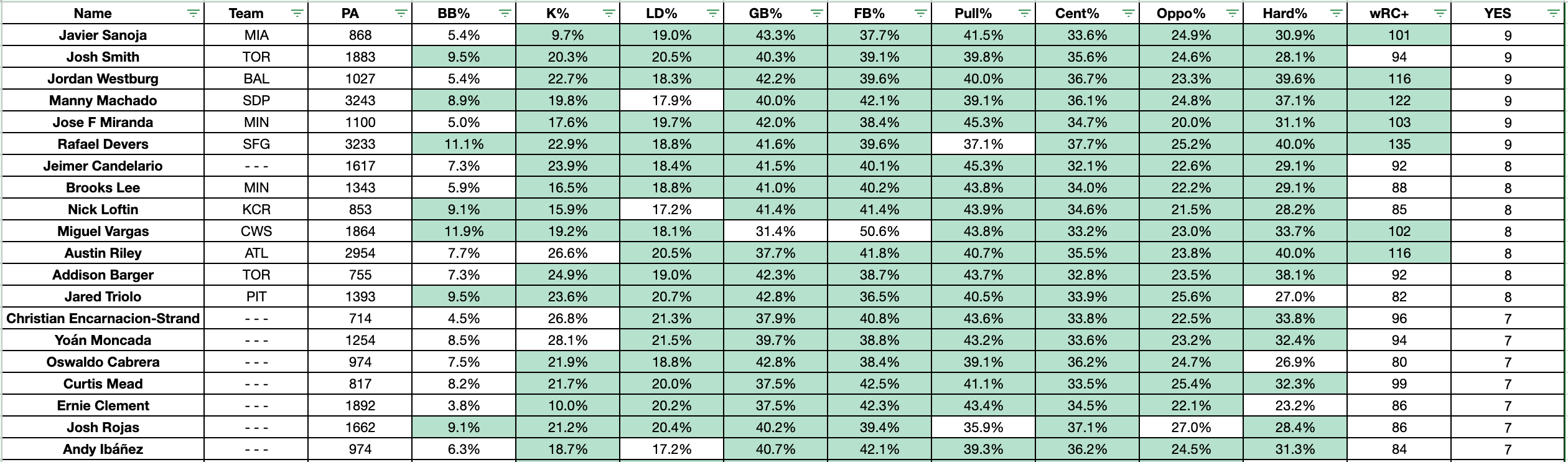
Initial glance at this list offers a handful of the usual suspects, especially when you consider players the Mariners have been tied to in the past, or players they logically make sense for in terms of the trade or free agent market.
In terms of the players who qualified in 9 of the 10 categories, Javier Sanoja and more so Jordan Westburg, have been popular trade candidate names for the Mariners.
Sanoja’s bat-to-ball skills model him similarly to a Luis Arraez batting profile, though with less success to date on his on base percentage, primarily due to him running a BABIP 40 points lower than Arraez’ career average. That said, Sanoja played at least 10 games at five positions this year (and played them extremely well) and won’t be arbitration eligible until 2028.
Westburg has long been linked to many Mariners’ fans mock trades, especially given Baltimore’s lack of pitching, and the Mariners lack of a third basement post Eugenio Suarez. Unfortunately, Westburg missed the majority of 2026 with an elbow injury, and there haven’t been any recent reports on his status outside of beginning his hitting progression at the end of September. Westburg will be arbitration eligible in 2027 and would come with three years of control, but has only averaged 87 games a season in his three years in the big leagues.
Yes, players like Manny Machado and Rafael Devers are on this list, both of whom theoretically can still play third base, but both contracts are absolutely non-starters for the Mariners organization, despite both fitting the team well in theory.
Additional Tidbits
Jose Miranda being one of 6 players who met 9 of 10 categories is very funny, and proof of the subtitle of this article.
Brooks Lee, Addison Barger, Miguel Vargas and Austin Riley all being in the 8/10 category are interesting thoughts - thought Lee and Vargas are likely off limits, while Riley falls in the Machado/Devers conversation above. The Mariners have reportedly been interested in Barger (also a PNW native) in past, so maybe there is a fit here.
Casey Schmitt, who the Mariners were linked to at the deadline, qualified in 6/10 categories, similar to former Mariner Eugenio Suárez.
José Ramirez also qualified for 6/10 categories - a datapoint that I 100% know for a fact is irrelevant
Free Agent to Be Alec Bohm qualified for 4
Primary Shortstops
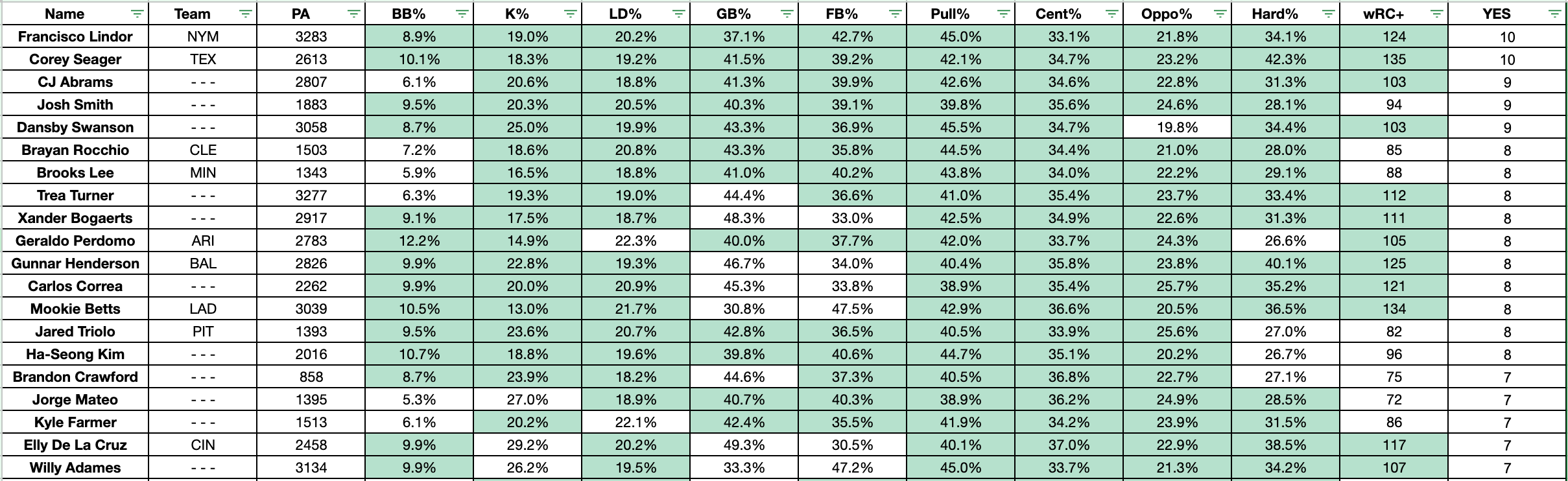
Surprise, surprise - two of the best shortstops (when healthy) in baseball lead the way on the list, and are our first members of The Perfect 10 Club™ in Francisco Lindor and Corey Seager. Unfortunately, both of these players can be immediately eliminated for a multitude of reasons (age, money, blood feud).
The next tier down does offer some more interesting options, though the two ‘most likely’ available have had very different trends in the past 12 months.
CJ Abrams, who I included in my off-season plan for the Mariners last season, is coming off a career year in which he posted career highs in almost every offensive category and posted his first career 30/30 season. There weren’t ever real rumors connecting Abrams to the Mariners, but there were real rumors surrounding Abrams availability in trade which even carried to the deadline this past season.
Unfortunately, this acquisition concept is incredibly tricky for a few reasons. As stated above, Abrams, value at this point couldn’t be higher. He has 3 years of control remaining, and at the age of 26, seems more likely to be a future cornerstone for a young rebuilding Nationals team than he is a trade piece.
Additionally, the Mariners desire to improve defensively would not be solved in any type of Abrams acquisition. As I wrote about last year, Abrams has been dead last in terms of Outs Above Average, and would be best suited to play any position other than shortstop moving forward. If there is a reason he could be available, this might be it (amongst other off-field related issues), but I would be surprised if the Nationals would accept anything less than a king’s ransom for a player coming off of the year Abrams just had.
The other player listed in the 9/10 category that could be of some interest to the Mariners would be long time Texas Ranger, current Toronto Blue Jay, Josh Smith. Smith, who has been best know for being a super utility type, is the polar opposite of Abrams in every sense of the word. Smith is coming off of his worst offensive season since his debut in 2022, but could be an interesting buy low candidate as a defensive chess piece. Smith still has three years of control remaining, but could be a non-tender candidate given his estimated arbitration number ($3.7m proj.), that is, if the Blue Jays don’t consider non-tendering potential third base option Ernie Clement ($7.6m proj.) instead.
Additional Tidbits
The 8/10 section of this list is littered with big names, who also come with big contracts (or questions). You can rule out players like Trea Turner, Xander Bogaerts, Carlos Correa and Mookie Betts (contracts), as well as Geraldo Perdomo (likely untouchable).
Jared Triolo being in the same group as the list above is very funny.
Elly De La Cruz is in the 7/10 group - and under no circumstance should that be held against him. Please figure out how to acquire EDLC.
J.P Crawford qualified for 6/10 categories, which is more than both Otto Lopez and Xavier Edwards, who each qualified with 5 respectfully. I am fairly certain the Mariners would be quite happy acquiring either Otto Lopez or Xavier Edwards at the right cost.
Potential George Kirby trade target Colson Montgomery qualified for 4/10 categories, though I think the strikeouts alone make that conversation fictional at best.
Defensive darling Joey Ortiz qualified for 3/10 categories - but man is that glove special.
Primary Outfielders
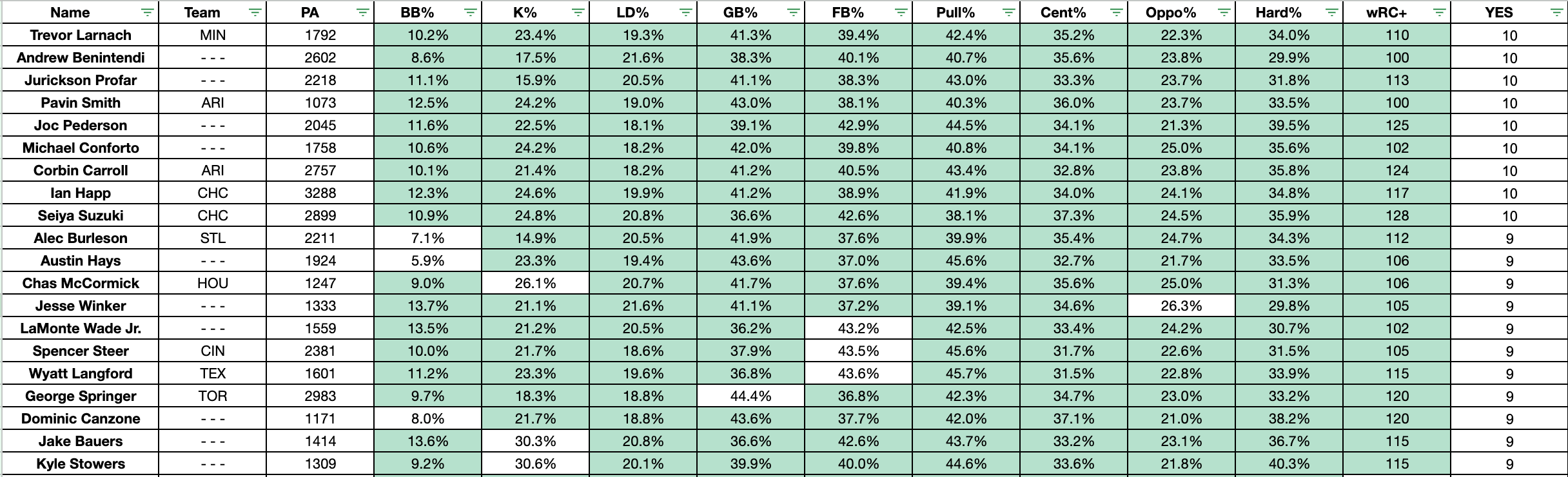
With the Mariners likely allowing Randy Arozarena to leave in free agency this off-season, and with potential incumbent Michael Arroyo very much needing more time to settle into a potential full-time role, the outfield dataset was certainly the one I was most interested in - and given it’s positional dataset being 50% larger than the shortstop and third base markets combined, it was likely to produce more options that could be fits in terms of W.I.M.
The Perfect 10 Club™ had a large representation in this dataset, providing a fairly wide contrast of players that could in theory find success in Seattle. Players like Andrew Benintendi, Jurickson Profar, Joc Pederson and Corbin Carroll are all likely non-options for the Mariners due for various reasons (age, money, blood feud, PEDs), but names like Trevor Larnach, Seiya Suzuki and Ian Happ all offer interesting Profiles for the Mariners.
Larnach is coming off of a career year in which he posted highs in terms of WRC+, but this is mostly due to the Twins adjusted usage rate of him. Larnach was almost strictly a strong side platoon hitter this year (55 PAs against LHP, 62 WRC+), though an argument can be made that those numbers look worse given his ghastly performance against LHP at home (5 WRC+!!!!). Larnach plays the Mariners now vacant left field position, which in theory, continues to push the idea that he could be a fit for the organization. That said, he would feel a little redundant as a LHH, below average defender, especially if the Mariners don’t choose to move on from Luke Raley, or if they plan to carry Lazaro Montes on the roster as well.
There is certainly a scenario where Larnach is a good fit for the Mariners, as a contract year strong side platoon player wouldn’t cost much, and he could be a natural partner with Arroyo in left field, but the Mariners would likely need to do a series of moves to make that fit, and there’s a possibility the organization could keep the prospect capital in tow, while also choosing to run with Luke Raley, who has also shown an ability to perform in T-Mobile.
In regards to Seiya Suzuki and Ian Happ, the Mariners would need to likely pay money that the organization typically has not for players at this stage in their careers. To be clear, this is not a negative reflection on the Suzuki or Happ. Suzuki posted a career high fWAR, his second highest WRC+ and had the best defensive season of his career. Happ, though down for his standards offensively, still posted a 2.5 win season while providing solid defense in a tough outfield environment in Chicago.
No, this is more the reflection that John Stanton recently stated in his end of season interview the Mariners, ahem, lack of interest in spending long term money on players in the age demographic that both Suzuki and Happ are in. Additionally, if the Mariners are going to spend on a Left Fielder in his early 30s, why not spend on the one who has already proven he can hit in Seattle over the past three years in Randy Arozarena? Yes, Arozarena will likely cost most in terms of years, and likely AAV, but he’s a proven commodity offensively for you, and was the best player on the 2026 Mariners despite some headaches along the way.
Though Suzuki and Happ would likely be good fits for the Mariners, and their data backs the potential that they could be successful in T-Mobile, the organization likely will look to find alternative routes to solving their left field hole for 2027 and beyond.
Additional Tidbits
Alec Burleson at 9/10 categories is an interesting fit for the Mariners, and one I mentioned in my off-season articles last year - but he’s likely more of a 1B/DH type, areas where the Mariners will likely not be shopping this off-season.
Frequently mentioned Spencer Steer also checks in at 9/10 categories, and it was rumored the Mariners had checked in during the regular season.
Steven Kwan clears 5/10 categories… which is the same as Pete Crow-Armstrong. Again, please refer to the subtitle of this article more my analysis here.
Byron Buxton is 3/10 categories cleared, so the Mariners obviously won’t be interested. The angry Minnesota Twins twitter fan can finally rest.
The dataset for outfielders is much larger, which has led to a much larger set of players that could be hypotheticals for the Mariners
Final Notes
At the end of the day, this model is by no means perfect, and can likely use some additional filtering and additions - such as all available hitters regardless of position, splits for left and right handed hitters, and potentially a smaller data set which shows or more recent dataset, as opposed to a larger one.
If you would like to review the document, feel free to visit the document here, and use it as your own reference point for when/if the Mariners eventually acquire players from this list this off-season.