

Note: This is part 5 of a 5 part series reviewing the 2026 Seattle Mariners.
Off-Season Captain’s Log - Part 1: 2026 Mariners Roster As Is
Off-Season Captain’s Log - Part 2: Free Agent Fits per Position
Off-Season Captain’s Log - Part 3: Trade Targets per Position
Off-Season Captain’s Log - Part 5: My Off-Season Plan
Prologue
First off, I would like to thank all of you who have followed along for this off-season series. I am truly grateful for all of the new subscribers who have signed up over the last few weeks, and especially thankful for those who have shared this project with others.
Moving forward, my frequency of posting will likely slow down barring any impactful Mariners news, but I do want to take the time to recognize some of the other very talented folks who write on Substack that you should also considered subbing to:
Colin O'Keefe - The View Level
Luke Arkins - Mariners Consigliere
Nathan, Ben, Colin and Luke all offer very different writing and recording styles and perspectives, but all four of them are incredibly talented at what they do, and will certainly help any fan who is looking for Mariners coverage through the cold winter months. Please take the time to support their work - they all deserve it.
With that said, we have reached the end of the off-season series here at Words from the Wharf, and with that, I am proud to share with you my plan on how to build the 2026 Seattle Mariners.
Move 1: Sign Josh Naylor
Contract Details: 4 years, $88m - Opt out after 2nd Season, Club Option for 5th year at $20m with a $2m buyout
I will start by saying that I (amongst basically everyone in the Mariners fan base) have continued to bang the table for the Mariners to re-sign Josh Naylor.
There really isn’t much to discuss here in terms of how he performed, mostly because anyone with eyes could see the impact Naylor had on the Mariners club down the stretch, despite him clearly being hampered by a shoulder injury which caused him to miss a few games.
Naylor wasn’t just good for the Mariners down the stretch, he was the best he has ever been, which was initially why I excluded him from the off-season plan (more on that shortly). From a high level standpoint, here was how Naylor performed for two months in Seattle as compared to how he has performed in any full season in his career:
WRC+: Career High
SLG: Career High
AVG: Second Highest
BABIP: Second Highest
FWAR/600: Double His Career High
Stolen Bases: LOL, LMFAO EVEN
Now as to why I didn’t include him in the Front Office plan, I do have a few concerns with Naylor.
First, the competition for Naylor’s service may wind up being a big problem. At 28, Naylor is younger for your average free agent, and as stated above, is coming off the best two month stretch of his career. There are a handful of big market teams (New York Mets, Boston Red Sox, Texas Rangers) who all have holes at 1B, and could push the financial commitment to a level the organization won’t feel comfortable committing to.
Secondly, and this might be the more important piece, is the expectations that Josh Naylor will ever be this good again. Naylor essentially performed as a 5.5 fWAR first baseman over the final two months of the season for Seattle, a pace he has never come close to sniffing through his career. Now, if Naylor can be a 2-3 fWAR player for the duration of the contract (as he has been for the last three seasons), you can live with a $22m AAV, especially considering the future money that will be coming off the books for the Mariners (J.P Crawford, Randy Arozarena). However, any sort of decline in performance by Naylor means tying a healthy portion of the organization’s typical budget to a slightly above average first baseman, and putting yourself in a position where future extensions or player acquisitions could be hindered by the contract you give out now. That said, it ain’t my money, and I do not worry myself with the financials of billionaires.
With all of that being said, the Mariners Front Office has been adamant that Naylor is their priority, and if there were a time for this regime to hand out a “bigger” contract than they ever have to an offensive player, it’s now. From a PR perspective, there isn’t a more slam dunk type signing for the organization than bringing Naylor back into the fold for the next 4-5 seasons. There is truly no player I have seen who has earned the unbridled love and support from this fan base this quickly, and his impact on the organization as a whole has been made quite evident based on comments from the players themselves, and the front office.
Move 2: Trade for CJ Abrams
Mariners Receive: SS CJ Abrams
Washington Nationals Receive: SHP Jurrangelo Cijntje, SS Felnin Celesten and OF Tai Peete
Though Abrams has played SS for the entirety of his career, I’m not so sure Abrams should continue to see that defensive position moving forward. Since 2022, CJ Abrams has ranked dead last (by a wide margin) in terms of Outs Above Average at the shortstop position (ironically, right in front of J.P Crawford).
Abrams’ biggest areas of concern in terms of fielding are on balls he has to charge, as well as balls hit to his left - which hypothetically could make him a difficult fit at third base, which would be the position I would hope the Mariners would try to transition him to if acquired. But at only 25 years of age, and with three years of arb control remaining, he is certainly a player the Mariners could look to take a chance on defensively, in the hopes that Perry Hill could help Abrams improve on the true weak point in his game.
Offensively, Abrams has averaged 19 home runs and 36 stolen bases over his last three full seasons, while also offering a slightly above average WRC+. Though his speed might lead you to think he could be a viable leadoff option, a spot in which he’s hit out of for more than 50% of his career, Abrams is not necessarily an on-base type, and has only carried a 5.3 BB% for his career. The Mariners would still likely slot Abrams into their leadoff spot in this scenario, primarily due to the lack of internal options.
From a compensation standpoint, the Mariners match up well for a Nationals club that is likely heading into a rather lengthy rebuild, and would be able to provide Washington with a few nice pieces that wouldn’t require the Nationals to start their service clock earlier than they would like.
Jurrangelo Cijntje’s calling card is that he is a switch handed pitcher offering a wrinkle that no other pitcher has been realistically capable of doing at the major league level. That said, his ability to be a switch pitcher has been exposed at the minor league level, but that doesn’t make him any lesser of a prospect in general.
Objectively, Cijntje is a high end RHP prospect who has the party trick of being able to throw with his left arm. As impressive as it is that he’s capable of doing both, his ability to consistently retire hitters from the south paw side at A+ and AA Ball just doesn’t offer much more than the occasional opportunity to deploy him from the bullpen if he develops more, or occasionally deploying him against LHH’s who struggle mightily against LHP.
Regardless of Cijntje’s ability to develop his LHP repertoire, he is still a universally agreed upon top 100 pitching arm who would likely be in AA or AAA for Washington at the beginning of 2026, with an outside possibility of breaking into their rotation, or joining their bullpen, by the end of the year, unless they wanted to delay his service clock for one more season.
Cijntje would slide in to the top 4 of the Nationals farm system, and would give the Nationals arguably the best rotation in the minor leagues between him, Travis Sykora and Jarlin Susana all potentially being in AA Harrisburg, or in AAA to start the 2026 season.
Felnin Celesten, who is arguably one of the best international prospects the Mariners have ever signed, has struggled to stay healthy during his time with the Mariners, which has led to him slipping out of a handful of top 100 prospect ranks.
Despite his injury history though, there are still prospect pundits (specifically Keith Law) who still view Celesten as a high end prospect with the defensive chops to stick at shortstop, with power that could develop as he continues to get older.
In terms of on-field performance, Celesten did struggle in his initial cup of coffee in A+ ball this year, but did so at the age of 19, which would have made him one of the youngest players in the league at the time. He spent the majority of his time in A ball this year, where he produced a 107 WRC+, with average walk and strikeout rates.
Admittedly, there is still more dreaming than proof of concept on Celesten at this point, and his value in any trade will likely need to come from an organization that chooses to see the potential more than his string of injuries that have limited him to 136 games in two stateside seasons. Given Washington’s lack of farm depth, and timeline to compete, I do think a player like Celesten is the type of prospect they would view as fit with the organization moving forward, pending their belief in his tools to take a step forward in 2026.
Tai Peete struggled offensively in 2025 with the jump to A+ ball, but there may not be another prospect in the Mariners system that has as much flash in his tools as Peete does.
Offensively, there is a continued concern with his plate discipline, as his last two seasons have ended with a strikeout rate north of 30%. Peete does show a great blend of power and speed, and finished only one home run shy of a 20/20 season in A+ ball this year, despite the strikeout issues.
Defensively, Peete transitioned from the infield dirt to centerfield this year, and did so with great success. Peete was a regular on the Mariners Minors Twitter account, and showed the speed and natural ability to stick in centerfield moving forward. In a Nationals system that is desperate for outfield help, and could likely see some of their current outfield options in the major leagues in other organizations by the time they are ready to compete, Peete would likely immediately rank as the best outfield prospect in their system, but would still be 2-3 years away from having any impact on the major league roster.
Move 3: Trade for Angel Zerpa
Mariners Receive: LHP Angel Zerpa
Kansas City Receives: 1B/OF Luke Raley, RHP Teddy McGraw and OF Victor Labrada
Tying back to my Trade Deadline Strategy article back in July, the Royals and the Mariners seem to be almost natural trade partners given the needs for both. The Mariners are in desperate need of another strikeout arm, particularly from the left side, while the Royals are in desperate need of additional production from their outfield, particularly now that Mike Yastrzemski has entered free agency.
Now, Zerpa hasn’t necessarily been a strikeout guy in his career, where he only has a 7.63 K/9, but what he does have is velocity, and a ground ball arsenal that led to him having a top five ground ball rate of all qualified relief pitchers in baseball last season.
Zerpa can be a little homer prone, however a transition to T-Mobile Park could help lower that for him, instead of the House of Horrors that is Kauffman Stadium in the summer time.
From a compensation standpoint, I viewed this similarly through the lense of the Gregory Santos trade from 2024, where the Mariners parted with a journeyman outfielder, a potential bullpen prospect with high octane stuff, and their Competitive Balance Round B pick that they had available to them. Given the Mariners do not currently have a pick to offer, I circled back to a trade proposal from the above mentioned trade deadline article where I proposed Dominic Canzone and Teddy McGraw for Lucas Erceg, but instead, subbed in Luke Raley as the outfielder of choice.
Raley had an injury filled 2025 which has left him in an interesting spot with the organization. Raley was given opportunities at first base, which could be valuable for the Mariners organization if they were left at the alter for any available options this off-season, but his performance there was… middling… to say the least. With the breakout from Dominic Canzone, Raley feels as if he might be best suited for a role with another organization. With three years of arbitration remaining, and two years of proven success in the majors, Raley acts as the pseudo-lead in this package for Kansas City, a team that finished dead last in major league baseball in terms of WRC+ from its outfield.
Teddy McGraw, in this case, acts as the value of the Comp B pick from the Santos trade. Currently ranked 14th in the Mariners prospect ranks, McGraw brings electric stuff, with three pitches (FB, SL, CU) that all have current 50 grades, with future value room to grow on each. Unfortunately, McGraw also brings a very long list of arm injuries, which inevitably lead to him falling to the 3rd Round of the 2023 Draft. At this point, McGraw is likely suited for a bullpen role. The Mariners did have him work as a starter this year, but he was limited to no more than 3 innings per outing. McGraw is Rule 5 eligible, though it would be a surprise to see a team take him to be on their 26 man roster for next season given he has not yet thrown a pitch above A+ ball.
Victor Labrada slides in as the DeLoach type in this deal, as a journeyman outfielder who has never really garnered much traction in prospect rankings, despite back to back productive years in the minor leagues. Already 25, Labrada is a small statured speedster type who saw a breakthrough in 2025 after making adjustments at Driveline during the off-season. Labrada posted career bests in average and OBP, while posting the second best WRC+ of his career. Labrada is Rule 5 eligible, and has been before - but his 2025 breakout might require whatever team employs his services to place him on their 40 man to avoid losing him in December.
Move 4: Mariners Sign Willi Castro
Contract: 1 year, $9m
In the final move, the Mariners look to continue to add flexibility to their roster by adding Willi Castro on a one year prove it deal, a deal he will likely now have to consider given his performance in Chicago following the trade deadline.
Castro was a very popular trade target this past July for Mariners fans, but was quickly forgotten about following the surprise plane ride by one Eugenio Suárez, and the middle of the night Passan bomb that sent the Mariners twitter-sphere into a tizzy.
Castro was on pace for this third straight season of posting at least a 106 WRC+ until his trade to the the north side of Chicago seemed to sap him of any BABIP magic he may have had in his time in Minnesota.
Prior to the trade, Castro ran a 109 WRC+, with league average strikeout and walk rates and a .742. OPS. Castro also added a much needed defensive flexibility to any club that acquired him, as he started at least 5 games at six positions in 2025. However, upon arriving in Chicago, Castro went into a tailspin, posting a paltry 40 WRC+ with a sub .500 OPS in 110 PAs for the Cubs. Though he was on their postseason roster for the Wild Card and Divisional Rounds, Castro saw zero plate appearances and would’ve been benched in September if not for injuries providing him opportunities to play.
With that said, Castro would offer the Mariners the utility type player they now have a need for, who would allow the organization to use him at almost every position on the diamond. He still managed a 109 WRC+ against left handed pitching, which would allow for him to pair well with a handful of players on the roster at multiple positions.
This move also allows the Mariners the flexibility to move Victor Robles into more of a true 4th outfielder if they so choose, as Castro could also offer a platoon option with Dominic Canzone, while allowing Robles to be more of a spot starter or defensive replacement late in games for either corner outfield spot. Castro could also handle 2B and 3B as a RHH partner for both Williamson and Cole Young if necessary.
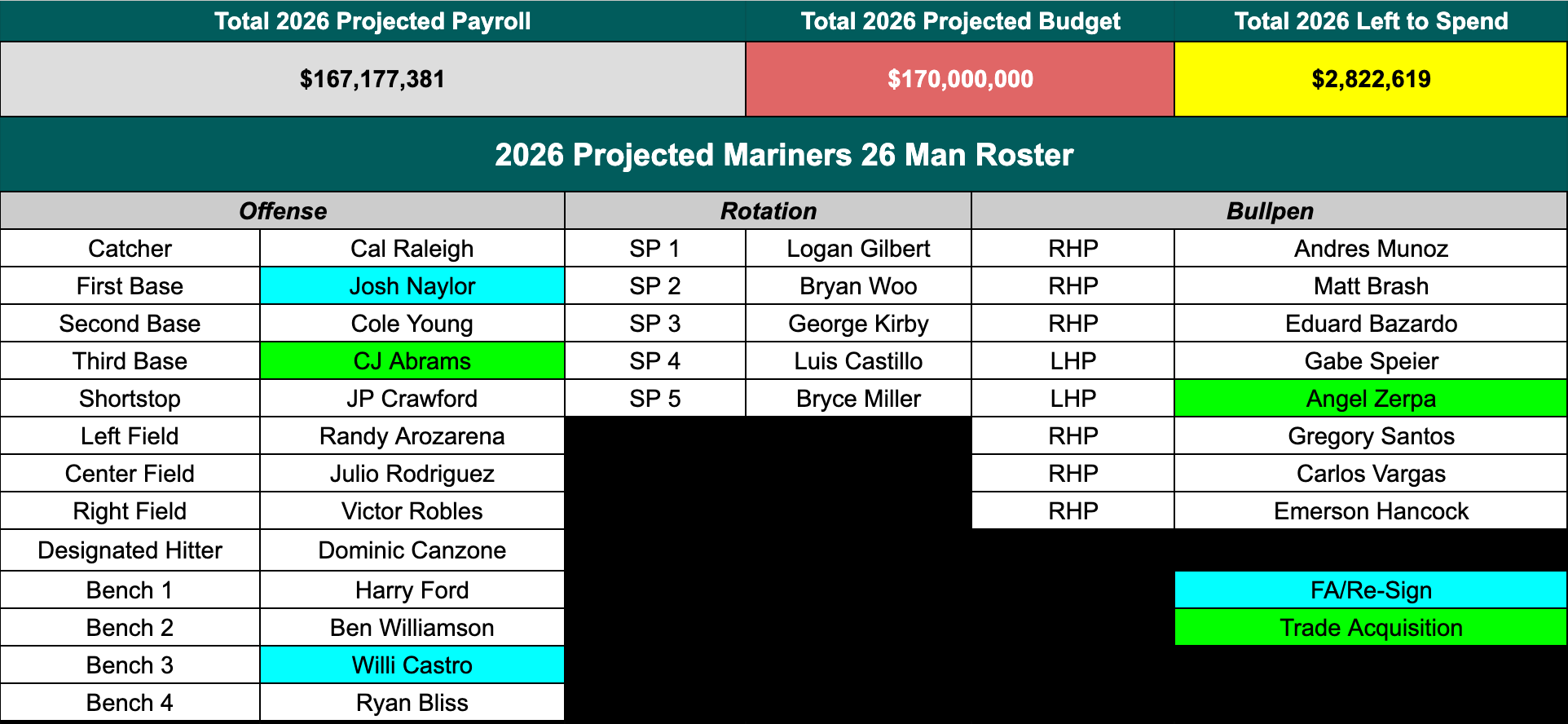
How The Roster Comes Together
Summary of Acquisitions
Arbitration: Non-Tender Trent Thornton and Tayler Saucedo, offer arbitration to all other players.
Free Agents: Josh Naylor and Willi Castro
Traded for Players: CJ Abrams and Angel Zerpa
Notes:
Payroll did end up staying under the $170m threshold by roughly $2.8m, but those numbers can be adjusted based on performance bonuses, arbitration estimates, etc.
Willi Castro is not listed as a starter, but would be likely act in a Dylan Moore like UTIL role, and would get regular starts in the OF as well as some time at 2B and 3B
Ben Williamson gets the last spot on the bench to provide a surefire defensive option at third base in case the Abrams solution does not work and Abrams needs to be shifted to 2B
In the above instance Cole Young would move to the bench, or potentially to AAA pending there is an alternate option in Tacoma that better fits the rosters needs
Dominic Canzone as my DH isn’t necessarily ideal, but it does feel as if the Mariners plans include Cal Raleigh getting more rest from behind the plate. I tend to hope that is the plan as well, especially if Cal’s defense continues to slide over the length of his contract
The bullpen’s final three spots of Hancock, Vargas and Santos are very interchangeable. The only likely lock here would be Vargas given he has no options remaining - both Hancock and Santos could be optioned to AAA in case a pile reliever makes the team out of camp.