

Preface
Welcome to the 2026-27 Words from the Wharf Off-Season plan.
A few house keeping pieces to include before we dive into the moves, and my analysis on why I chose the path I did.
I am sticking with the budget that Ty Dane Gonzalez and Colby are using over at Locked On Mariners - $170m.
I’ve tried to be more ‘Jerry-Brained’ in my last few iterations, including the writing I have done here in past - but for this season, I am trying to be a little more aggressive - especially with the likely more blank canvas approach the front office will be dealing with compared to the last few seasons.
I won’t be doing a Manager selection, as I don’t think it impacts the off-season in any way shape or form.
I will cover arbitration, club options, signings, trades and extensions - spoiler: just because I tender a player a contract does not mean they’ll be on the roster at the end.
I used ahoybaseball.com (s/o Ty on the build) to structure my off-season plan, including the roster construction (26 and 40 man) as well as the financials. I do believe it is paywalled, so if you are interested in using the same tool, be sure to subscribe to Control the Zone over on Patreon.
With all of that out of the way - lets get started.
Arbitration Decisions
Tendered:
RP, Eduard Bazardo ($1.5m)
RP, Matt Brash ($1.8m)
OF/DH, Dominic Canzone ($3m)
RP, Cooper Criswell ($900k)
UTIL, Brendan Donovan ($6.1m)
RP, José A. Ferrer ($1.6m)
SP, Logan Gilbert ($15.4m)
SP, George Kirby ($9.8m)
SP, Bryce Miller ($3.9m)
OF, Luke Raley ($3.1m)
RP, Michael Rucker ($800k)
RP, Gabe Speier ($3.3m)
RP, Carlos Vargas ($800k)
SP, Bryan Woo ($5.2m)
Non-Tendered:
1B/3B, Patrick Wisdom
Club Options
Pick up option for Andrés Muñoz ($8.0m)
Declined Club option for Bryce Miller ($6.075m - $15k buyout)
Tendered Bryce Miller a contract at his arb projection ($3.9m)
Decline Option for Victor Robles
Sign 3B/OF Teruaki Sato
Contract: 4 years, $72m ($11.8m also due in posting fee)
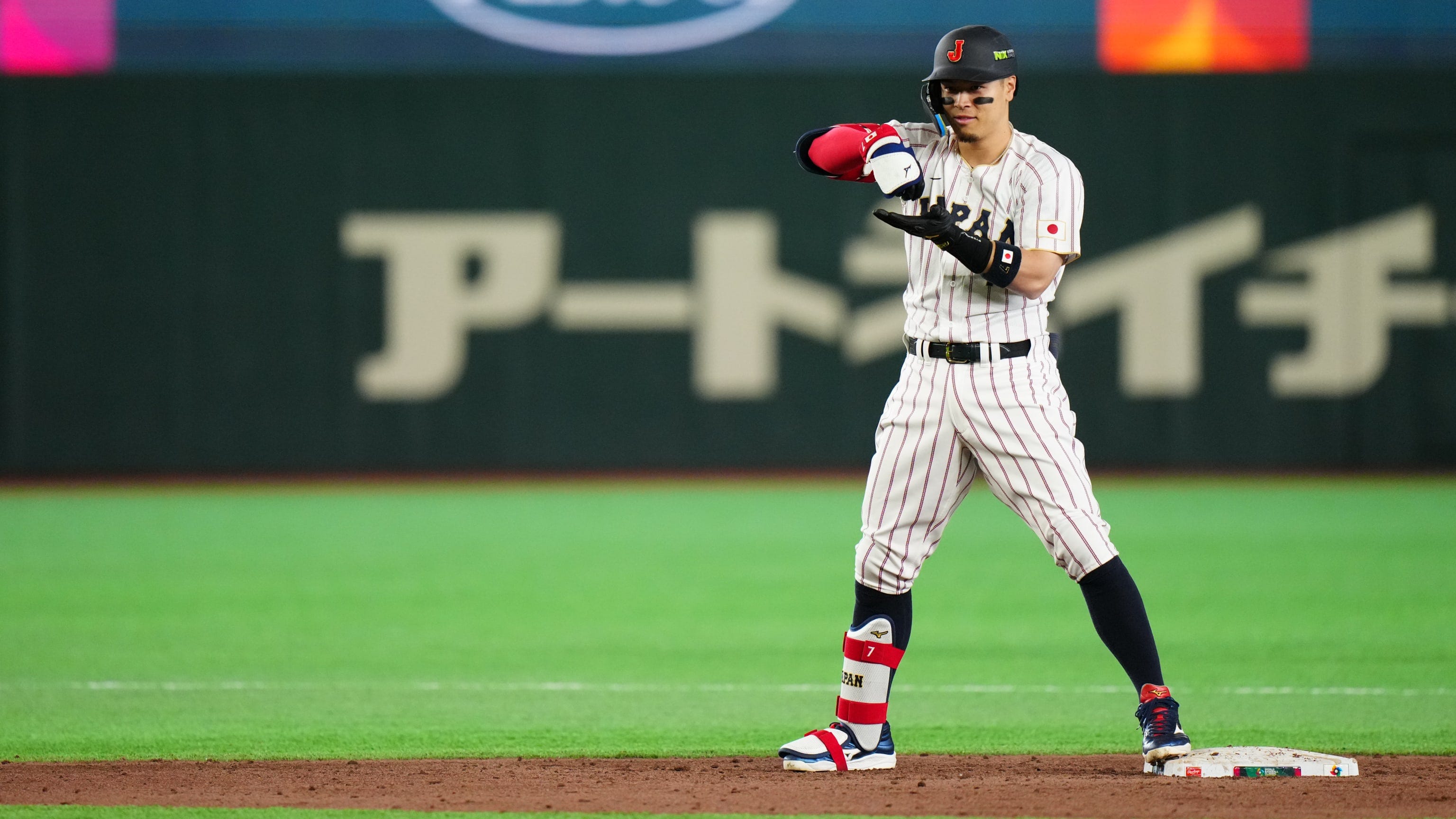
Let’s start with the picture associated with the article, and explain why the financial expectations that I think many believe will be tied to Sato, just aren’t reflective of the type of players that Japan has sent stateside over the last 5+ seasons.
Thanks to a very helpful tweet from @YankeesFocus on Twitter we are given a great summary of the breakdown on where Sato stands across the most prominent Japanese hitters that have made their way to the MLB most recently:
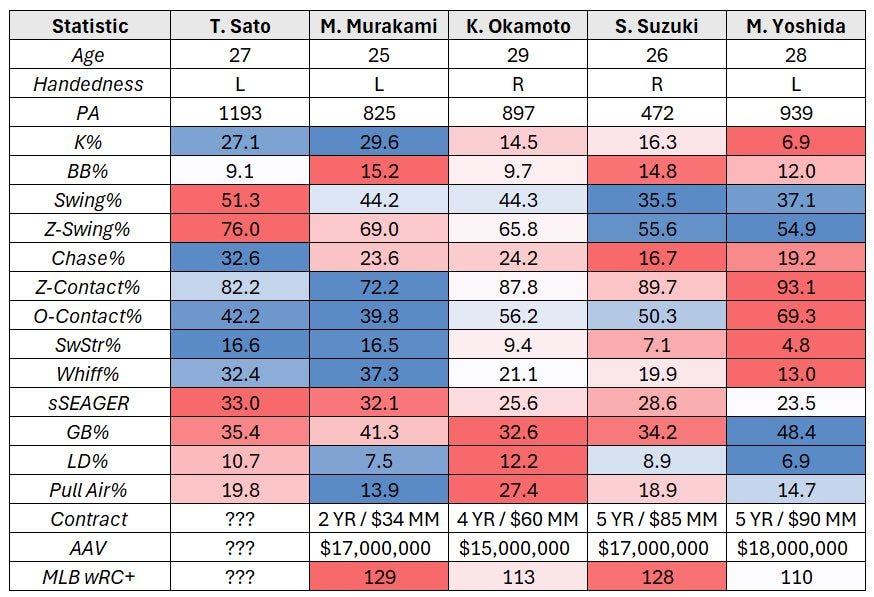
The quick summary here is, well, Sato is a very aggressive hitter, who carries the lowest walk percentage of any of the major names in recent memory. On the surface, you would think that this would be a dealbreaker for a team like the Mariners, who have spent the better part of the last decade preaching about dominating the zone from the mound, and in the box.
But despite the issues with walk percentages, Sato carries healthy line drive percentages, and more importantly for a lefty in T-Mobile, very healthy pull air percentage numbers - which would very much help Sato continue his power stroke stateside. That said, given the recent results of Munetaka Murakami in his debut season, you can likely expect Sato to run a 30% strikeout rate in the big leagues initially, which, given his walk rate, means he will need to hit, and hit big, to carry his offensive profile.
Financially, the Masataka Yoshida contract is the high mark here, but that contract was also heavily criticized at the time of signing, which has seemingly impacted the years and AAV players coming over from Japan have received since. Sato will be playing his first season in the bigs at 28, so it is also hard to see him getting the fifth year that Seiya Suzuki and Yoshida received, especially given the difficult market Murakami faced last year due to his swing and miss issues, as well as his shortcomings defensively.
Now, Sato is not considered the defensive liability Murakami was, but his future may very well be in the outfield instead of third base - positions the Mariners currently have multiple openings for. For the sake of this exercise, I am having the Mariners sign Sato to be their every day third baseman, however, the following moves in my off-season plan set the stage to allow Sato the flexibility to move to the outfield eventually if the defense becomes an issue.
Given the Mariners openness on not wanting to give big money contracts to older free agents, as well as their own, ahem, self-imposed financial restrictions - players like Sato are the types of risks the organization needs to take, especially after watching the success of both Murakami and Okamoto last year.
At 4 years and $72m, Sato matches the high water AAV mark set by Yoshida, while also getting the opportunity to hit free agency again at the age of 32, something that Seiya Suzuki will be doing this year, with a likely healthy market bidding on his services.
It is important to note that the Mariners would also need to pay the posting fee due to the Hanshin Tigers for making him available to the MLB, which would add an additional $11.8m that the Mariners would need to pay, bringing the technical value of the contract to 4/$83.8m.
The Mariners have spent plenty of time sitting on the sidelines in true free agency over the years, and this plan doesn’t stop at Sato as the only acquisition in free agency, but he is the most important. Given the questionable future at third base, as well as the corner outfield positions for the Mariners, signing Sato gives them a floor they likely don’t have with other options internally, and allows them the flexibility of moving him to his best suited position over time.
The organization missed their chance with Okamoto last year - they would be wise to not make the same mistake twice.
Three Way Trade
Mariners Receive: SS Zach Neto
Braves Receive: SP George Kirby
Angels Receive: 2B/SS Tate Southisene (ATL), LHP Briggs McKenzie (ATL), OF Carter Beck (ATL) and C Luke Stevenson (SEA)
This was easily the most important decision of the entire off-season plan, which also made it the most challenging. The level of difficulty also increases when you know that everyone who is writing an off-season plan would likely be including a Kirby deal, so you also need to do your best to find a deal that hasn’t already been discussed frequently, or at a minimum, doesn’t feel like it’s too good of a fit to be true (Arizona in particular).
I went through several iterations of a George Kirby trade before landing here, including trying to find ways to trade him to Miami (Javier Sanoja or Heriberto Hernández), Baltimore (Jordan Westburg++) or the Cubs (Pedro Ramirez++) - but with each one of those deals, I kept feeling like I either wasn’t getting enough in return due to a second piece being whelming at best, or that it was more me wanting the piece the other team had more than they would likely want or need Kirby.
I can hear many of you reading this currently expressing your uncertainties with a Mariners/Angels deal in general - but it is important to remember that the entire existence of the Angels organization that is responsible for decision making no longer exists. Gone are the likes of Arte Moreno and Perry Minasian - replaced now by the Kroenke Conglomerate and a yet to be determined front office group making the decisions moving forward.
Simply put, the Angels organization, top to bottom, is an absolute nightmare, and is in need of a talent infusion in their minor league system as they likely embark on a long-ish rebuild to build the franchise Kroenke envisions them becoming.
Adding to this, a new report from Robert Murray recently surfaced speculating that Zach Neto would be one of the most likely names to be traded prior to the pending lockout - and the Mariners interest is Neto is nothing new, given the Mariners had reached out to the Angels regarding Neto at the deadline this previous year. With all this in mind, as well as the Mariners glaring hole at shortstop, makes it clear that Neto would be a fit - but how?
Sure, the Mariners have prospects to get a Neto deal done on their own if they would like, however, there is certainly a level of uncertainty the organization might feel in trading the best of the best from their farm to a division rival, and it is not like the Mariners organization in general to go all in on acquisitions, especially with their prospect capital.
That said, the Mariners have not necessarily hidden the fact that they know they need to deal from their rotation to likely address some of their offensive issues, especially given the cost of free agents in general, and their, ahem, self-imposed budget - but a team like the Angels are certainly not a fit for players like George Kirby or Emerson Hancock, especially if a new leadership group rightfully identifies that the next successful version of the Angels most likely lines up with the same time frame of their rumored new stadium.
If you’re going to trade a George Kirby, your best return is likely going to be in the form of high helium prospects, as Kirby’s recent performance over the last two seasons have certainly dulled the shine of his profile in general. But despite the dip in Kirby’s value, there are certainly teams out there who would find significant value in a reliable middle of the rotation starter who still has the ceiling to be much, much more, especially if said team thinks they can find the adjustments to unlock the version of George Kirby many expected to see heading into the 2025 season.
Enter, the Atlanta Braves.
If there is any team that has had bad luck in terms of pitching health, it is the Braves. Over the past two seasons, almost every single starter for the Braves have suffered significant injuries which has led Atlanta to dig deep into the depths of their own farm to fill innings throughout the season. A pitcher like George Kirby, who despite missing time in 2025, has averaged 162 IP over his five seasons in the majors and would be a very welcome addition to the Braves rotation, likely slotting in no worse than third in the Braves current rotation, and would allow the Braves more flexibility in potentially trading, or shifting to the bullpen, Spencer Strider.
Now, in a cost-for-cost vacuum, I did my best to compare Kirby’s evaluation similarly to the Freddy Peralta trade from last year. Yes, Peralta was coming off a significantly better 2025 than Kirby is in 2026, but Kirby does come with an additional year of control. Additionally, Peralta and Kirby’s 2023-2024 side-by-side does offer a glimpse of the type of pitcher George Kirby can be, one who clearly outperformed Peralta in just about every metric with the exception of K/9.
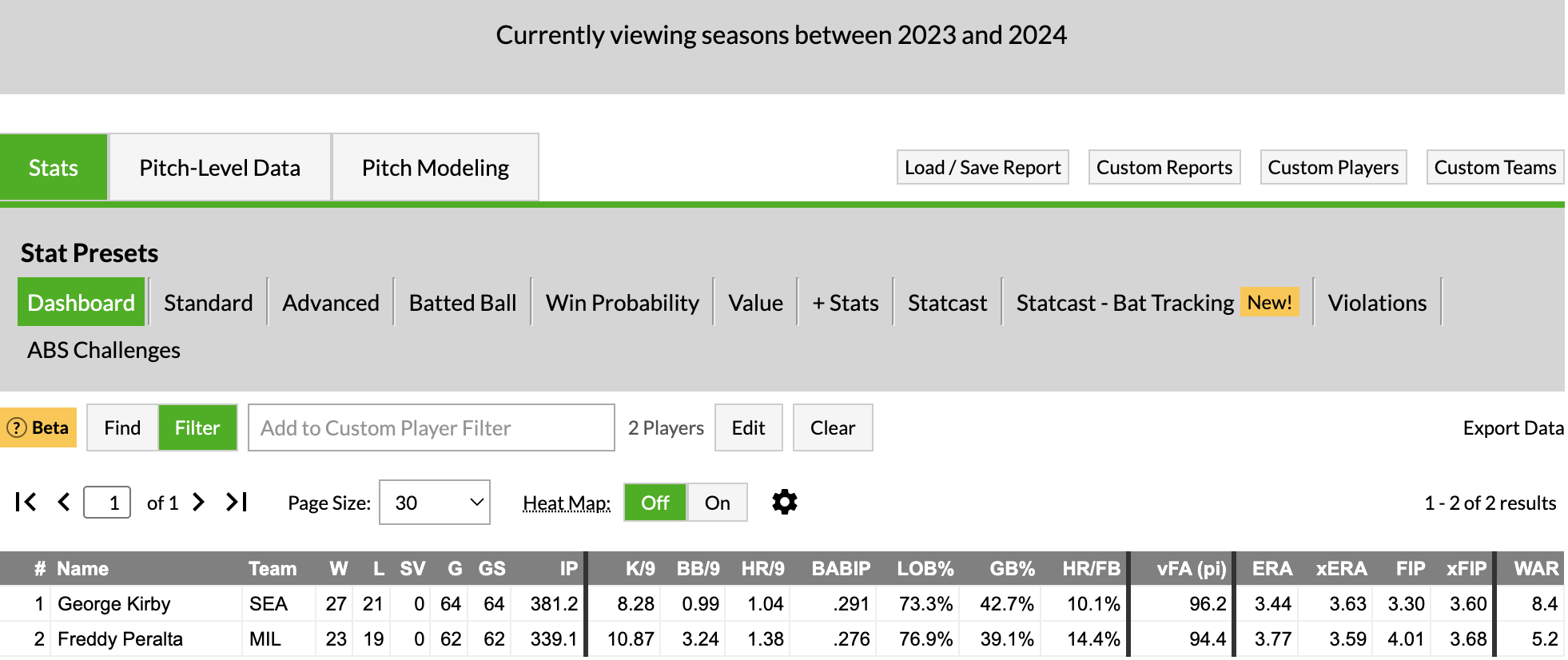
The Mets cost for the Peralta deal was Jett Williams, who at the time, was ranked 30th in baseball in MLB Pipeline, as well as Brandon Sproat, who ranked 6th overall in a good Brewers system - so in order for the Braves to get George Kirby from the Mariners, the Braves would need to give me a similar prospect package (which as seen above would be re-routed to the Angels for Zach Neto).
Tate Southisene currently comes in as 58th in the most recent MLB Pipeline Top 100, but carries a higher Future Value grade per Fangraphs than the above mentioned Jett Williams does (50 to 45). Southisene is still a few years away from debuting in the majors, which as mentioned above, is likely the top of prospect the Angels should be looking for at this point, and carried the following update from Fangraphs at the trade deadline -
Tate Southisene shrugged off a discouraging debut cameo in Low-A last year, and after battering Carolina League arms for a couple months, was recently promoted to High-A Rome. He’s changed his setup at the plate, quieted some of his mechanics, and shortened his swing. The cumulative effect is that he’s been able to make a decent rate of contact while still tapping into his power, which is comfortably average already. He has also stolen 44 bases and has a chance to become a plus defender at short. With this recent update, he enters our Top 100.
Briggs McKenzie comes in as the second piece from the Braves, and helps the Angels potentially dream on a front of the rotation in the 2030’s headed by a pair of high helium lefties in McKenzie and “Probably Should’ve Been A Mariner If Not For The Angels” Tyler Bremner. McKenzie is currently not ranked in any top 100 lists, but showed serious growth, both physically and professionally in the past year per Fangraphs -
Briggs McKenzie is the other big climber. He got the largest bonus in Atlanta’s 2025 draft class as a slender and projectable lefty with advanced feel to pitch but below-average arm strength. A year later, he’s filled out some, added several ticks, and has a chance to grow into even more velocity. He’s surged into the Top 10 of this system and made a real case for midseason Top 100 inclusion. We’d like to see him hold this stuff deeper into games and over more innings before we toggle that lever, but the arrow is up here.
Finally, Carter Beck comes in as the final piece from the Braves, which on paper, completes the Mariners’ compensation for Kirby with a unanimous top 100 piece (Southisene) with a 50 FV, a fast rising 45+ FV LHP in McKenzie, and Beck (35+ FV) who was earmaked by Fangraphs for a re-grade based on the Braves evaluation on him as seen below:
Carter Beck is a flier worth a mention here. He was taken late in the first round, and while he wasn’t really in that orbit on our draft rankings, it’s going to be pretty exciting to watch the Braves try to run it back with another cold-weather prospect, à la Hartman and Owen Carey. He’s one I’ve already earmarked for a fresh re-eval on the offseason lists.
Now, it is important to point out that the Angels farm system currently lacks a frontline catching prospect, and that was not addressed in the Braves portion of this trade - but, after the Mariners acquisition of Boston Smith, and his subsequent emergence in their system, Seattle now has a healthy backstop organizational situation between Cal Raleigh, Jhonny Pereda, Luke Stevenson and the above mentioned Smith.
With that said, the Mariners add Stevenson to this trade to help push the Angels forward in trading Neto to a division rival, which despite the explanations above, likely still comes with a certain tax.
Now there really isn’t much to discuss on why Neto fits the Mariners, as we already have reviewed the Mariners current hole at shortstop, and their previous interest in him - but it is important to note that Neto and Sato allow the Mariners to slow play Colt Emerson in his return from injury, and gives him the additional seasoning he likely needs in AAA that he was not awarded from the organization in 2026. Furthermore, a potential Sato’ move to the outfield could hypothetically solve a future 2028 issue where Brendan Donovan is no longer under contract for the Seattle Mariners, and allows the organization to decide between Neto and Emerson’s roles on the left side of the infield.
From a value perspective, would you trade George Kirby and Luke Stevenson for Zach Neto?
This writer says yes.
Would the Braves trade a top 100 prospect, and two additional top 15 organizational prospects, all of whom won’t likely debut until 2028 at earliest, for two years of George Kirby?
This writer says yes.
Would the Angels take a package headlined by players who won’t impact the roster until 2028 at earliest, as well as adding 3 prospects to their top 10, as well as an additional top 20, for Zach Neto?
This writer says yes.
In my opinion, this is the best route for a return for Kirby, whether it’s a Neto trade, or another three way deal where the Mariners can essentially turn Kirby into a prospect package they flip for a bigger name from a third team - but given the smoke around the Mariners and Neto from before, and the Angels likely stepping back with their eyes towards the future, this trade felt like the right move for all parties.
Sign UTIL Mauricio Dubón
Contract: 2 years, $23m, (3rd year option of $10m, with a $2m buyout)
Mauricio Dubón will very likely be a hot commodity this off-season for most teams, especially given the defensive flexibility he provides, but again - I can hear the groans from the readers seeing a 11.5m AAV being given to a right handed hitter in his early 30s with a career 90 WRC+, but I’m going to need you all to hear me out for a second.
Is it your money? No? Okay - then don’t worry about it.
The point here is not for Dubón to come in and be the centerpiece of the Mariners off-season like they have done in past with players like Mitch Garver.
It is also not the point for him to even be the 2nd piece coming in for the Mariners this off-season. No, the point of Dubón is to come in and offer the Mariners a second super utility type option, similar to Brandon Donovan, but without the elaborate injury history, while also not needing to be relied upon as a primary everyday bat for the Mariners to be successful.
As you will see when I post the final structure of my lineup at the end of this writeup, Dubón will not be expected to bat outside of the bottom third of the lineup, and though he is slotted in LF against RHP (due to his reverse splits in 2026), he offers the ability to play every position on the diamond (except catcher), and play those positions well.
Point blank, Dubón allows the Mariners to rest every starter on the field, with the exception of maybe Josh Naylor, and allows you to do so without seeing incompetence at the plate. There is a lot of value in lengthening your bench with flexibility and floor, and Dubón offers both.
Trade OF Luke Raley and RHP Charlie Beilenson to the Cleveland Guardians for RHP Colin Holderman
With the Guardians likely facing a financial crunch with Jo Adell and Steven Kwan expected to make roughly $20m combined in arbitration, Cleveland will likely be looking for cost controlled corner outfield help as they likely look to trade one, if not both, in order to save money as the organization typically does.
Luke Raley when healthy has been a fun piece for the Mariners, and at times an important one, as he has shown the ability to do what many can’t - hit in T-Mobile Park. However, Raley has struggled with his health over the last two seasons, and now faces a roster where Dominic Canzone has rightfully earned an every day spot, and where slugger Lazaro Montes will continue to make a case for his position on the roster. Essentially, Raley’s inability to stay healthy has led to him being redundant on a Mariners roster that has also now added/pushed Brendan Donovan and Mauricio Dubón (as well as our next acquisition) into an outfield that for my roster, will also include Michael Arroyo and Julio Rodriguez.
With the Guardians looking for some additional corner outfield help, and the Mariners likely looking for some fresh blood in a bullpen that struggled in 2026, both teams feel like a natural fit for an arbitration swap of a reliever and outfielder.
Colin Holderman is coming off a close to career year with Cleveland, but is set to hit Arb 3, and is projected to make $2.3m, which is roughly $800k less than Luke Raley. Holderman primarily served as a medium to low leverage reliever for Cleveland, where he primarily used his Sinker (+9 PV) and Sweeper (+5 PV) roughly 75% of the time. If there is some concern, it’s that Holderman did have surgery to relieve tendinitis in his throwing wrist, but he is scheduled to be ready for the upcoming season regardless of start date.
I do have the Mariners including Charlie Beilenson as an arm that could potentially make the Guardians ball club out of camp, as I do feel the Mariners likely would need to include an extra small piece given the performance of both players in recent years.
Important to note, the Rule 5 Draft is very much in question this year with the looming lockout, so the Guardians wouldn’t have the option to acquire Bielenson via that route despite Beilenson being Rule 5 eligible.
Trade RHP Eduard Bazardo to the Cincinnati Reds for OF Dane Myers
With the departure of Raley, the Mariners find themselves in a position where they don’t truly have a backup centerfield option outside of Mauricio Dubón - a position I would prefer to keep Dubón away from in case Cole Young’s LHH issues continue, or in case Dubón needs to cover for Donovan for the exact reason.
The Mariners also likely find themselves in a position where it wouldn’t be the worst idea to turn over some of their relievers who have carried a heavy load over the past few years, and there is no bullpen arm who has thrown more for the Mariners over the last two years than Eduard Bazardo.
Bazardo leads the Mariners by 26.1(!!!) innings and 16(!!!) appearances over the last two years, which also does not include the mileage put on his arm throughout the 2025 postseason run as well.
As admirable of a job as Bazardo has done for the Mariners, I am of the mindset that I would prefer to move on from the wear and tear Bazardo has accumulated, especially if there is a team in desperate need of a bullpen arm who has thrown leverage innings.
The Reds had the 4th worst bullpen in terms of fWAR, and the 6th worst in terms of ERA in 2026, and find themselves in a position where their best reliever in Brock Burke will be hitting free agency. Bazardo is by no means a guarantee, but given the ballpark the Reds play in, the organization has to take their chances in trades instead of relying on relievers to sign up for half of their home games in Great American Ballpark.
Dane Myers would instantly provide the Mariners with their second best defensive outfielder, and a much needed upgrade to allow Julio Rodriguez more rest days, or at DH, throughout the season. Myers, 30, is a short side platoon, had a 115 WRC+ and a .777 OPS against LHP last year, an area the Mariners GREATLY struggled in. Similar to Bazardo, Myers would come with three years of control.
Extend RHP Logan Gilbert
Contract: 6 years, $141m
I won’t dive into this too much, as I think it’s pretty straightforward for why the Mariners should do this - but admittedly, I don’t know if this will get it done for Logan.
Should it? It’s tough to say - his comp is a lesser Dylan Cease to an extent, but even that isn’t perfect. With only one year of control remaining, Gilbert may be better suited to take his shot at having an elite year on a likely shortened schedule, and try to cash in next off-season - but there is injury risk here, and he’s one bad pitch from choosing the wrong briefcase on the Deal or No Deal stage.
As for structure, I didn’t lower Gilbert’s arb number to make anything work - instead, I marginally increased it ($15.4m to $19m) with the following schedule:
2027: $19m
2028: $22m
2029-2032: $25m AAV
Personally, I think this is a good faith offer to Logan, and still puts him in a position where he could potentially snag one more smaller term contract at 35 when he’s a free agent again - but I wouldn’t be surprised if this still isn’t enough to lock Logan up to be a Mariner for life.
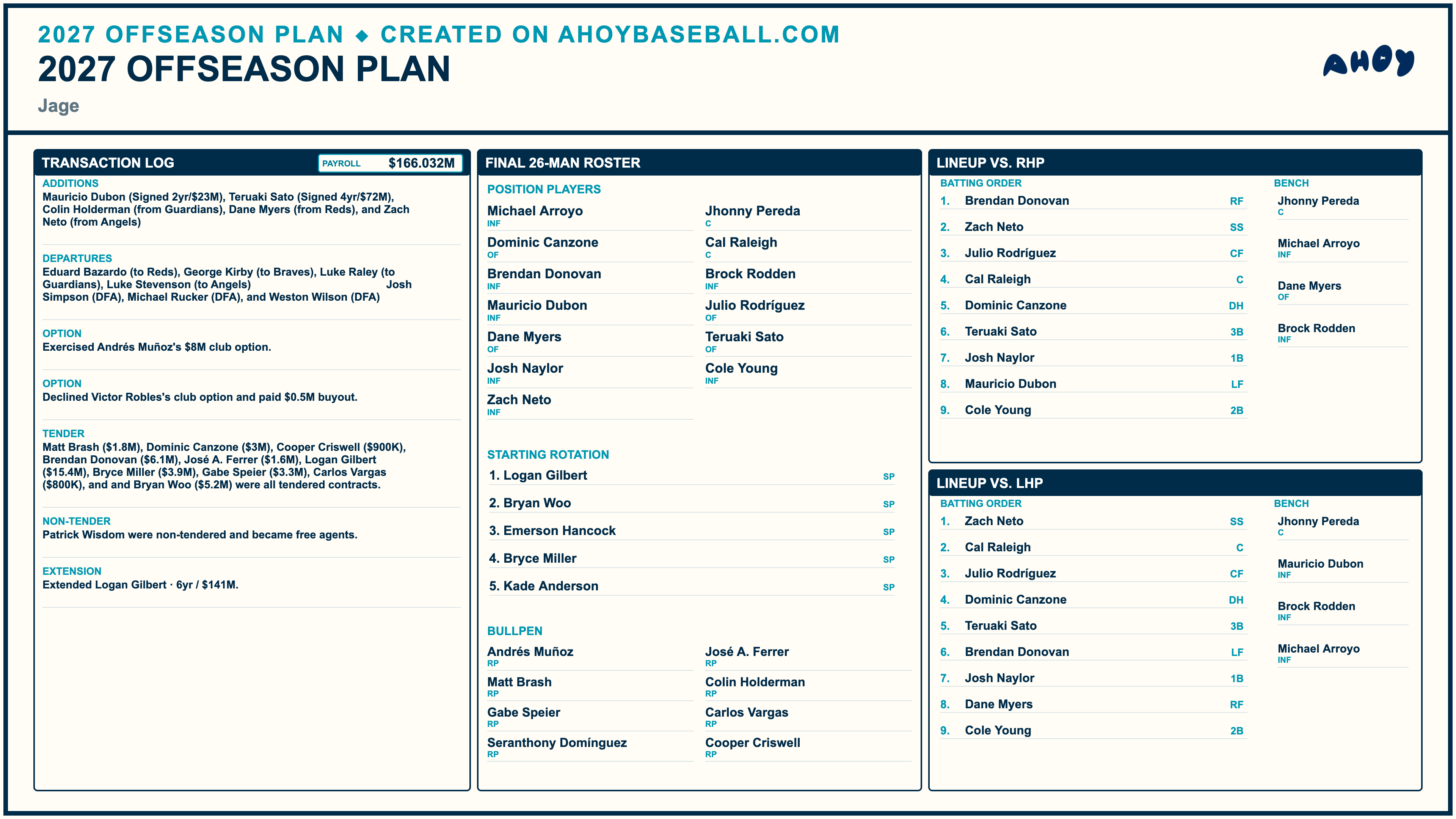
Final Roster:
I like the Kirby trade but not including Stevenson