

Note: This is part 4 of a 5 part series reviewing the 2026 Seattle Mariners.
Off-Season Captain’s Log - Part 1: 2026 Mariners Roster As Is
Off-Season Captain’s Log - Part 2: Free Agent Fits per Position
Off-Season Captain’s Log - Part 3: Trade Targets per Position
Off-Season Captain’s Log - Part 4: The F.O Off-Season Plan
Off-Season Captain’s Log - Part 5: My Off-Season Plan (Coming Soon)
Prologue
With the review of the 2026 Roster as is, Free Agent Fits and Trade Targets out of the way, I wanted to take two different routes to handling an off-season plan.
Given some fans (this author included) like to put together their own off-season plans on how the Mariners could fill out a roster, I often find that regardless of staying within the same restrictions (money, prospects, etc.), my plan often varies from what I believe the front office will actually wind up doing.
With that in mind, I decided to put together two separate plans this year - the first plan, which will be outlined in this write-up, will be centered around how I think the front office would handle the off-season, while the second plan (to be released later) will be focused on how I would handle the off-season if I was in charge of roster construction.
Current Roster and Expected Restrictions
NOTE: All references of financials and current roster structure will come from Fangraphs Roster Resource, with numbers rounded for easier math. I will also only focus on expected payroll for the 26 man roster. All prospect rankings will be utilized through MLB Pipeline due to them being the most up-to-date.
Current Payroll for 2026: $134m
Expected Payroll for 2026: $170m
Current Under Contract Players:
SP, Luis Castillo - $24.15m, signed through 2027 with a vesting option for 2028.
C, Cal Raleigh - $12.67m, signed through 2030 with a vesting option for 2031.
CF, Julio Rodriguez - $20.18m signed through 2029, with conditional club options after 2029 (8 or 10 years), with alternative player options for 2030-2034.
SS, J.P Crawford - $12m signed through 2026.
RF, Victor Robles - $5.12m signed through 2026 with a club option in 2027.
Current Option Eligible Players:
2B/DH, Jorge Polanco - $6m player option for 2026
(Update: this was declined by Polanco)
RP, Andrés Muñoz - $7m club option for 2026, $8m club in 2027, $10m club in 2028
(Update: this was picked up by the club)
Current Arbitration Eligible Players:
Randy Arozarena - MLBTR Projected - $18.2m
Trent Thornton - MLBTR Projected - $2.5m
Logan Gilbert - MLBTR Projected -$10m
Gabe Speier - MLBTR Projected - $1.7m
George Kirby - MLBTR Projected - $5.4m
Luke Raley - MLBTR Projected - $1.8m
Matt Brash - MLBTR Projected - $1.8m
Gregory Santos - MLBTR Projected - $800k
Bryce Miller - MLBTR Projected - $2.4m
Tayler Saucedo - MLBTR Projected - $1.1m
Current Pre-Arbitration Eligible Players:
RP, Eduard Bazardo
RP, Carlos Vargas
SP, Bryan Woo
RF/DH, Dominic Canzone
UTIL, Miles Mastrobuoni
C, Harry Ford
2B, Cole Young
2B, Ryan Bliss
2B, Leo Rivas
3B, Ben Williamson
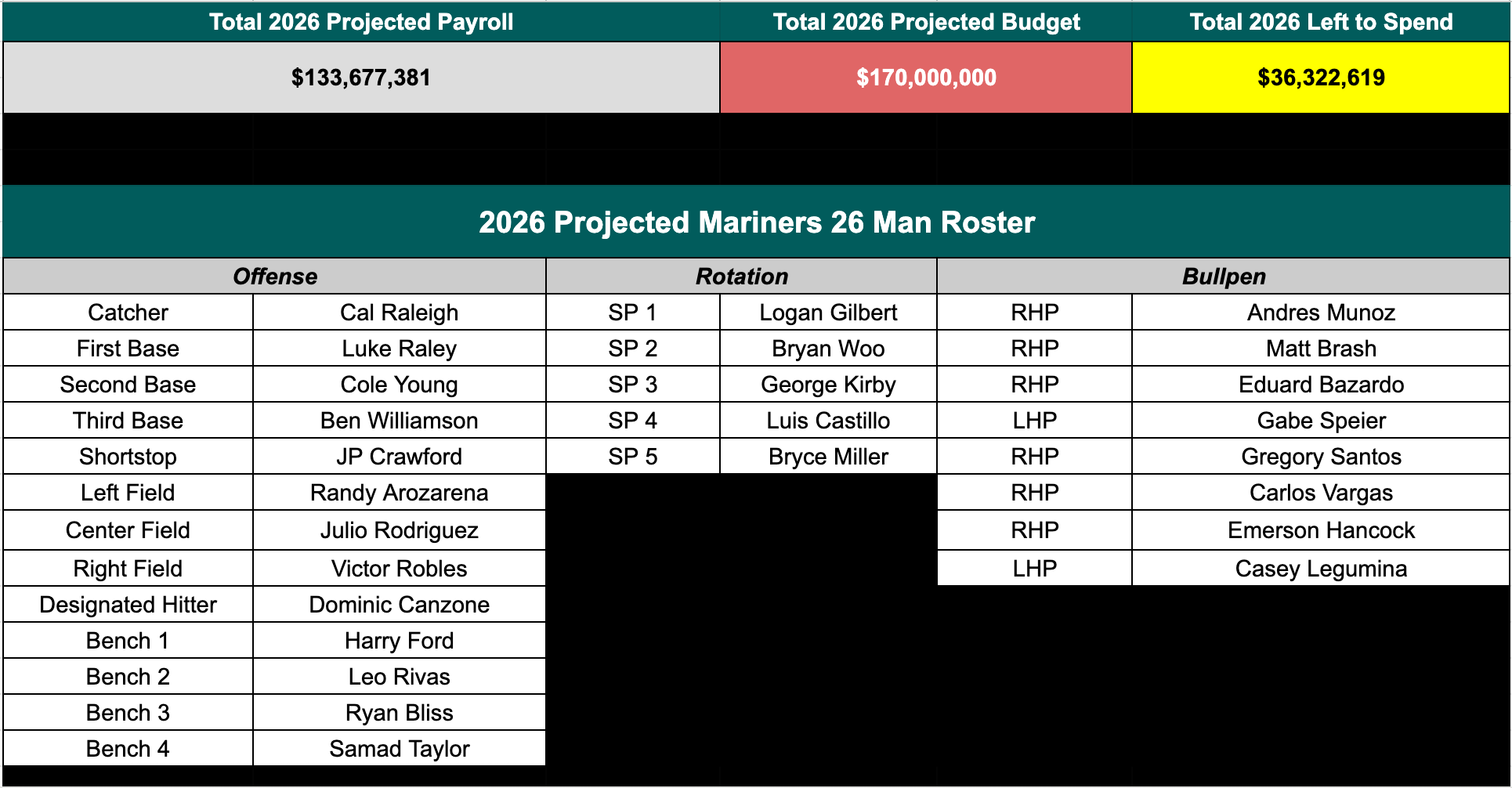
Current Expected Lineup, Rotation and Bullpen:
Arbitration Decisions
The Mariners will likely move on from both Trent Thornton and Tayler Saucedo, thus freeing up roughly $3.6m in projected arbitration cost.
Thornton, unfortunately, suffered a season ending achilles injury following the trade deadline, and will likely be sidelined for most if not all of 2026 as well. I do believe there is a high chance the Mariners would bring back Thornton on a MiLB deal regardless, but there’s no scenario I can see where the Mariners will be willing to pay $2.5m for a reliever you may not see in 2026.
Saucedo’s non-tenure is more performance based, and is more clear considering his injury filled 2025, as well as his spot on the pecking order in the bullpen. Realistically, the Mariners can look for non-arbitration eligible arms who could fill a theoretical second lefty spot in the bullpen, and there is always a chance they could sign Saucedo back on a minor league deal if he’s open to it.
Move 1: Re-Sign Jorge Polanco
Contract: 2 years, $30m ($15m AAV) with a 3rd year club option at $15m ($2m buyout)
If you are wondering why the first move of the off-season is Jorge Polanco, and not the beloved Josh Naylor, let me explain.
First of all, I tend to believe that of the upcoming free agents leaving the Mariners roster, Polanco will likely be the easiest to re-sign. I had laid out on Twitter a potential avenue I would hope the Mariners could explore, where they could hypothetical convince Polanco to opt in to his 2026 contract, while also giving him a two year extension to guarantee him until 2028. However, I am operating in the mindset that Polanco will either re-structure, or opt out (he did) and test the open market.
Admittedly, I see Polanco’s market looking very similar to Mitch Garver’s from 2023, where his lack of durability and age will slot him slightly lower than what his market could have been if he had performed in 2024 the way he did in 2025.
Yes, Polanco had an incredible 2025 season, however, given Polanco has:
Played more than 118 games once since ‘22
Averaged 113 games a year in full seasons (non-COVID/14-15)
Has posted 2+ fWAR 3 times in ten years
Is going to be playing ‘26 in his age 33 season
I’d be pretty surprised if his market went much higher than the $15m AAV I have proposed in this deal. That said, I do believe the front office would look to structure Polanco’s contract similarly to that of Garver’s by adding on an additional club option at a lower AAV, but with a buyout that would bring his total guaranteed money to $32m.
Now, there is also an additional reason for why I have Polanco listed as the first move in this plan, and it is certainly going to upset most of you who read this.
I do not believe the Front Office will inevitably go the extra distance to re-sign Josh Naylor this off-season.
Seeing projections from outlets such as The Athletic and Baseball America have me concerned that the Front Office will look at Naylor, and understand that there is a likely limited growth to what he can be as a player moving forward despite his age. I do think the front office will do what it can to re-sign him, however, I do think other teams such as the Mets and Red Sox could be willing to go to 5 guaranteed years, or to a higher AAV than the Mariners front office will be comfortable going to.
By the beginning of the 2026 season, I expect that only one of Eugenio Suarez, Josh Naylor or Jorge Polanco will be in a Mariners uniform, and of the group, Polanco feels like he’s the most likely.
AUTHOR’S NOTE: Polanco officially opted out of his contract on November 5th.
Move 2: The Mariners acquire Brandon Lowe
Mariners Receive: 1B/2B/DH Brandon Lowe
Tampa Bay Receives: UTIL Brock Rodden and RHP Troy Taylor
When doing an off-season plan that revolves around the front office, and how we think they may operate, it almost feels reckless to not include the Tampa Bay Rays as part of the strategy. To date, Jerry Dipoto in his tenure has made seventeen trades with the Tampa Bay Rays (JUST KIDDING IT’S EIGHTEEN NOW), by far the most he’s made with any franchise.
Now, with the Rays under new ownership, there is always the possibility that their operating styles may change - but until we see that, we will continue to operate under the idea that the Rays will trade players who make real money, especially when that player has minimal control remaining - Brandon Lowe, as it so happens, falls into both of those categories.
Lowe continued his consistency in 2025, posting a 114 WRC+ and a .784 OPS, which does fall in line (though slightly short of) his career averages. Lowe did unfortunately see a noticeable dip in production over the second half of the season, including an ugly .217/.247/.398 line over the course of September and October.
What was noticeable for me, however, was Lowe’s home road splits, and how he actually hit significantly worse in the very friendly George Steinbrenner Stadium than he did on the road. At home, Lowe had a .240/.279/.456 line for a 97 WRC+, but on the road, hit .275/.337/.500 for a 132 WRC+.
As I had laid out in the third part of this series, I went back and forth on Yandy Diaz vs. Brandon Lowe as the better fit for the Mariners, but inevitably landed on Lowe after seeing Diaz’ increase in slugging being a bit of a product of hitting in the third friendliest ballpark for right handed hitters.
For his career, Lowe has seen a fair amount of success playing in T-Mobile Park, where over 48 PAs has a .943 OPS, though that does come with a slightly elevated K rate (29.1% compared to 27.3% career). Obviously this is a small sample size, but identifying hitters who have seen success in Seattle specifically does tend to ease the mind of this author.
Financially, Lowe has a club option for 2026 worth $11.5m, and on top of the $15m already promised to Polanco in this plan, more or less splits the potential money (plus a few million) owed to Josh Naylor across two players who would help cover first base, second base and designated hitter when Cal Raleigh is behind the plate.
In terms of compensation, I tried my best to model this deal to a lower compensation to that of the Teoscar Hernandez deal from 2022, where the Mariners traded an at the time top 10 prospect (weaker farm in 2022) in Adam Macko, and three years of control of Erik Swanson, who at the time, was coming off of a career year. At the time, Teoscar, 30, was coming off of a 3.0 fWAR year, with a 130 WRC+ and wound up earning $14m through arbitration. Lowe will be slightly less expensive, but is a year older and has not put up a season like that since 2021.
In return, the Rays get UTIL Brock Rodden who is currently ranked 22nd in the MLB Pipeline Mariners Top 30. Rodden has been in the Mariners system for 3 years now, and will be Rule 5 eligible come December, and must be included on the 40 man roster in order to avoid being subject to the Rule 5 draft.
Rodden had an injury riddled season in AA Arkansas, where he posted a .293/.365/.452 line with a 139 WRC+ in one of the most pitcher friendly parks in minor league baseball - and was shut down permanently in August after suffering a fractured hamate. In his previous full season in 2024, Rodden posted a 116 WRC+ across two levels, but struggled initially upon his debut in Arkansas. Rodden has spent time at 2B, SS and 3B in his time with Seattle, and could serve as a potential utility man for Tampa as early as 2026 pending his injury heals, and he picks up from where he left off in 2025.
Troy Taylor is a bit of a wild card option here for Tampa Bay, but of all the organizations to take a shot on the glimpses seen from Taylor in 2024, it might be them.
Taylor had a disastrous season in 2025, going from someone who was expected to be a part of the backend of the bullpen in February, to a guy running a 28% HR/FB rate in 44.2 IP in AAA. Taylor showed glimpses of who he could be in the major leagues in 2024 when he had a 3.39 xFIP and a 11.64 K/9 in 19.1 IP, but somewhere along the line between then and now, something has clearly gotten out of whack for Taylor, to the point where he has become a bit of an afterthought for most fans.
That said, Tampa could view this package as two players who could contribute on their roster as early as 2026, and would both come with 5+ years of control - which could likely be what it takes to get Lowe to Seattle.
Note: This package could be considered light, but it is almost impossible to understand Tampa Bay and their wants and needs. I think most Mariners fans would view the Randy Arozarena deal as a win for the Mariners based on the names that they didn’t give up, however, the Rays did the deal regardless. I would be amendable to adding just about any non-top half prospect to this package and wouldn’t really flinch.
Move 3: Mariners Acquire Angel Zerpa
Mariners Receive: LHP Angel Zerpa
Kansas City Receives: 1B/OF Luke Raley, RHP Teddy McGraw and OF Victor Labrada
Tying back to my Trade Deadline Strategy article back in July, the Royals and the Mariners seem to be almost natural trade partners given the needs for both. The Mariners are in desperate need of another strikeout arm, particularly from the left side, while the Royals are in desperate need of additional production from their outfield, particularly now that Mike Yastrzemski has entered free agency.
Now, Zerpa hasn’t necessarily been a strikeout guy in his career, where he only has a 7.63 K/9, but what he does have is velocity, and a ground ball arsenal that led to him having a top five ground ball rate of all qualified relief pitchers in baseball last season.
Zerpa can be a little homer prone, however a transition to T-Mobile Park could help lower that for him, instead of the House of Horrors that is Kauffman Stadium in the summer time.
From a compensation standpoint, I viewed this similarly through the lense of the Gregory Santos trade from 2024, where the Mariners parted with a journeyman outfielder, a potential bullpen prospect with high octane stuff, and their Competitive Balance Round B pick that they had available to them. Given the Mariners do not currently have a pick to offer, I circled back to a trade proposal from the above mentioned trade deadline article where I proposed Dominic Canzone and Teddy McGraw for Lucas Erceg, but instead, subbed in Luke Raley as the outfielder of choice.
Raley had an injury filled 2025 which has left him in an interesting spot with the organization. Raley was given opportunities at first base, which could be valuable for the Mariners organization if they were left at the alter for any available options this off-season, but his performance there was… middling… to say the least. With the breakout from Dominic Canzone, Raley feels as if he might be best suited for a role with another organization. With three years of arbitration remaining, and two years of proven success in the majors, Raley acts as the pseudo-lead in this package for Kansas City, a team that finished dead last in major league baseball in terms of WRC+ from its outfield.
Teddy McGraw, in this case, acts as the value of the Comp B pick from the Santos trade. Currently ranked 14th in the Mariners prospect ranks, McGraw brings electric stuff, with three pitches (FB, SL, CU) that all have current 50 grades, with future value room to grow on each. Unfortunately, McGraw also brings a very long list of arm injuries, which inevitably lead to him falling to the 3rd Round of the 2023 Draft. At this point, McGraw is likely suited for a bullpen role. The Mariners did have him work as a starter this year, but he was limited to no more than 3 innings per outing. McGraw is Rule 5 eligible, though it would be a surprise to see a team take him to be on their 26 man roster for next season given he has not yet thrown a pitch above A+ ball.
Victor Labrada slides in as the DeLoach type in this deal, as a journeyman outfielder who has never really garnered much traction in prospect rankings, despite back to back productive years in the minor leagues. Already 25, Labrada is a small statured speedster type who saw a breakthrough in 2025 after making adjustments at Driveline during the off-season. Labrada posted career bests in average and OBP, while posting the second best WRC+ of his career. Labrada is Rule 5 eligible, and has been before - but his 2025 breakout might require whatever team employs his services to place him on their 40 man to avoid losing him in December.
Move 4: Mariners Acquire Brendan Donovan
Mariners Receive: UTIL Brendan Donovan
St. Louis Cardinals Receive: RHP Logan Evans, 2B Michael Arroyo and OF Tai Peete
With two years of arbitration control remaining, Brendan Donovan fits this front office’s mold of acquiring players in their arbitration years. Despite my previous thoughts on why I think acquiring Donovan to play 3B would be a poor use of his skillset in my previous article, this plan is meant to be from the eyes of the Front Office - and given the organization tried to justify Jorge Polanco as their starting third baseman in 2025, it would not surprise me in the least to see them try the same thing with Donovan.
Donovan has experience playing almost every position on the diamond outside of catcher and centerfield, with the lion share of his time over the last two seasons being at second and in left. Given the inevitable free agency of Randy Arozarena in 2027, Donovan would potentially solve multiple issues for the Mariners over multiple seasons, while also adding some additional flexibility in 2026 in case of injury across the diamond.
Donovan has played third base only 15 times in the past three seasons, including zero appearances in 2025, but he did appear in 31 games at third in 2022, with positive results in terms of Outs Above Average. It might be a stretch to expect he could just pick it back up in 2026, but again, the front office has tried other less likely fits as recently as this March.
Logan Evans might not have the allure to a healthy portion of the fan base in terms of what his value can be, but for a St. Louis Cardinals ball club who is looking to trade Sonny Gray, and will enter the season (barring free agent adds) with potentially 3-4 spots in their rotation up for grabs, Evans fits a need as someone with major league experience who can come in and compete for a job immediately.
Evans started 15 games for the Mariners this year with rather pedestrian results. His 4.32 ERA is inflated from two very rough starts in Sacramento and New York, but his FIP being above 5 also suggests that overall body of work was actually relatively lucky.
His 6.53 K/9 is lower than you would hope from a starter, but he does have a minor league track record of a much more palatable 8.72 K/9. Evans uses a six pitch mix to help keep batters off-balance, but his future may be dictated on figuring out which of those pitches can get more consistent swing and miss. He is likely a back of the rotation type arm, but could eventually be looked at again for a bullpen role, something the Mariners tried in 2024.
Michael Arroyo will undoubtedly be the most painful piece in this trade for most readers, but with two years of control on an above average proven bat in Brendan Donovan, it’s unlikely the Mariners will be able to complete this trade without parting with one of their higher range prospects.
Arroyo is the definition of “have bat, will travel” in terms of his prospect pedigree. Through three full seasons in the minors, Arroyo has yet to post lower than a 128 WRC+, and has flown through the Mariners system, finishing the year in AA Arkansas at the age of 20. Arroyo will likely start his 2026 in Arkansas again, but it wouldn’t be a shock to see Arroyo in AAA prior to the end of the year, with an outside shot of reaching the big leagues if his hitting continues.
The one struggle with Arroyo is where exactly you put him in the field. He saw some growth at 2B defensively, but there have been early rumblings that the Mariners could potentially give him more of a look in the outfield next season. The bat will likely keep him comfortably in most top 100 rankings, but his defensive limitations will likely keep him from breaking into the upper echelon of prospect sheets.
Tai Peete struggled offensively in 2025 with the jump to A+ ball, but there may not be another prospect in the Mariners system that has as much flash in his tools as Peete does.
Offensively, there is a continued concern with his plate discipline, as his last two seasons have ended with a strikeout rate north of 30%. Peete does show a great blend of power and speed, and finished only one home run shy of a 20/20 season in A+ ball this year, despite the strikeout issues.
Defensively, Peete transitioned from the infield dirt to centerfield this year, and did so with great success. Peete was a regular on the Mariners Minors Twitter account, and showed the speed and natural ability to stick in centerfield moving forward. In a Cardinals system that is desperate for outfield help, Peete would likely immediately rank as the best outfield prospect in their system, but would still be 2-3 years away from having any impact on the major league roster.
Move 5: Mariners Sign Willi Castro
Contract: 1 year, $9m
In the final move, the Mariners look to continue to add flexibility to their roster by adding Willi Castro on a one year prove it deal, a deal he will likely now have to consider given his performance in Chicago following the trade deadline.
Castro was a very popular trade target this past July for Mariners fans, but was quickly forgotten about following the surprise plane ride by one Eugenio Suárez, and the middle of the night Passan bomb that sent the Mariners twitter-sphere into a tizzy.
Castro was on pace for this third straight season of posting at least a 106 WRC+ until his trade to the the north side of Chicago seemed to sap him of any BABIP magic he may have had in his time in Minnesota.
Prior to the trade, Castro ran a 109 WRC+, with league average strikeout and walk rates and a .742. OPS. Castro also added a much needed defensive flexibility to any club that acquired him, as he started at least 5 games at six positions in 2025. However, upon arriving in Chicago, Castro went into a tailspin, posting a paltry 40 WRC+ with a sub .500 OPS in 110 PAs for the Cubs. Though he was on their postseason roster for the Wild Card and Divisional Rounds, Castro saw zero plate appearances and would’ve been benched in September if not for injuries providing him opportunities to play.
With that said, Castro would offer the Mariners another utility type to go with Brendan Donovan, who would allow the organization to use him at almost every position on the diamond. He still managed a 109 WRC+ against left handed pitching, which would allow for him to pair well with a handful of players on the roster at multiple positions.
This move also allows the Mariners the flexibility to move Victor Robles into more of a true 4th outfielder if they so choose, as Castro could also offer a platoon option with Dominic Canzone, while allowing Robles to be more of a spot starter or defensive replacement late in games for either corner outfield spot. Castro could also handle 2B and 3B as a RHH partner for both Donovan and Cole Young if necessary.
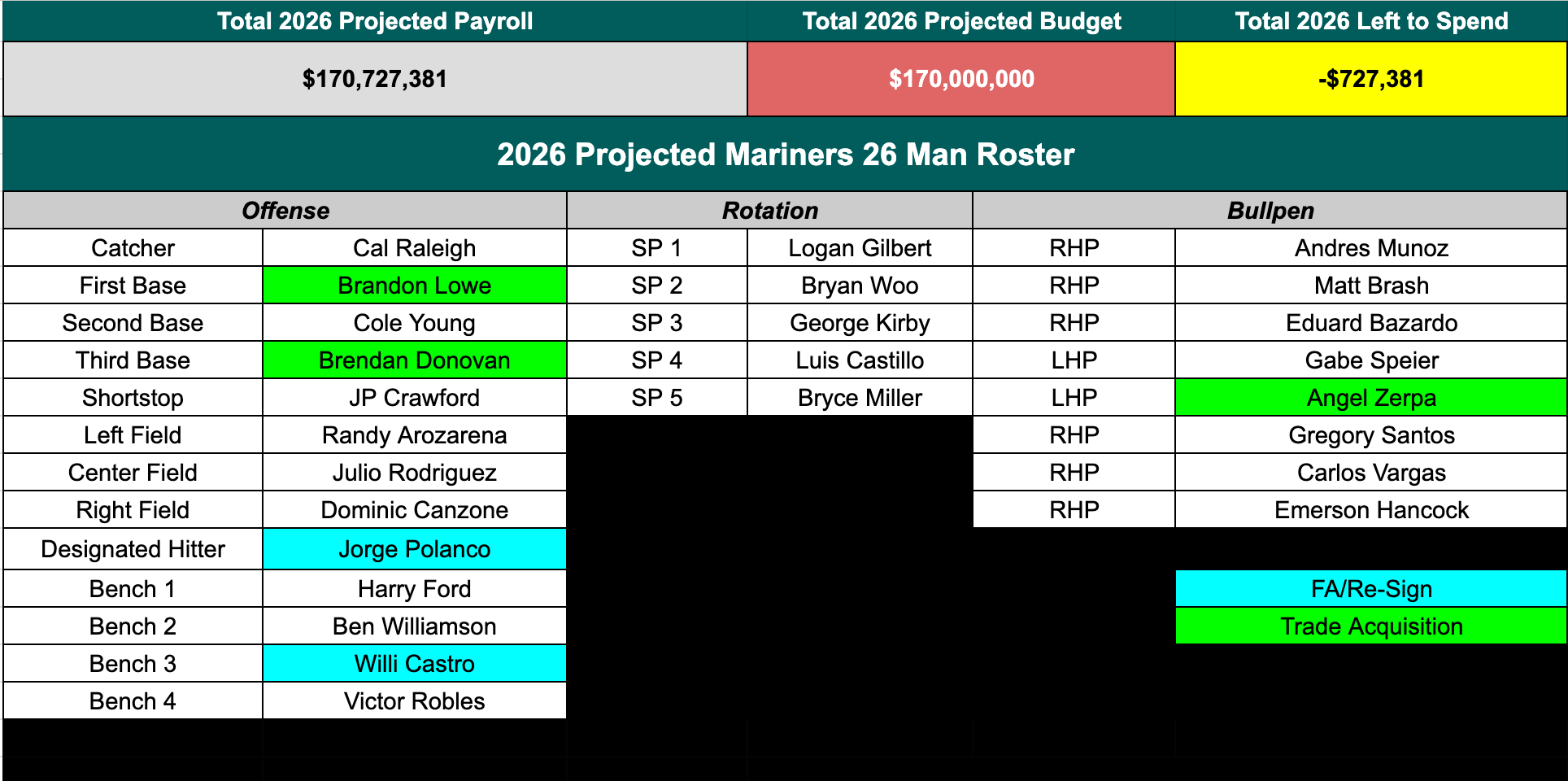
How The Roster Comes Together
Summary of Acquisitions
Arbitration: Non-Tender Trent Thornton and Tayler Saucedo, offer arbitration to all other players.
Free Agents: Jorge Polanco and Willi Castro
Traded for Players: Brandon Lowe, Brendan Donovan and Angel Zerpa
Notes:
Payroll did end up clearing my $170m threshold by roughly $725k, but those numbers can be adjusted based on performance bonuses, arbitration estimates, etc.
Willi Castro is not listed as a starter, but would be against LHP as seen below
Ben Williamson gets the last spot on the bench to provide a surefire defensive option at third base in case the Donovan solution does not work
Donovan would move to second base full time in this case, and Cole Young would move to the bench, or potentially to AAA pending there is an alternate option in Tacoma that better fits the rosters needs
First Base is definitely light with backup options, but backup 1B is not really an option on rosters, and Polanco would serve as your emergency option based on him getting some non-game reps there in 2025
The bullpen’s final three spots of Hancock, Vargas and Santos are very interchangeable. The only likely lock here would be Vargas given he has no options remaining - both Hancock and Santos could be optioned to AAA in case a pile reliever makes the team out of camp.